

To pay for your reading on your telephone bill, simply call
Instantly message our featured psychics online via psychic messenger.
Click to start
Register now to start your reading online. PSYCHIC MESSENGER- Cheapest psychic service in the UK
- Our readers are available 24/7
- 100% confidential service
- In-depth, concise, personal readings
- Thousands of 5* reviews
Published 19/03/2023 • Updated 16/11/2026 by Joanne Jones
Death Tarot Card Meaning
Upright, Reversed, Love, Feelings & Symbolism
By Joanne Jones, Founder of Trusted Psychics | Psychic Medium, Astrologer & Tarot Expert
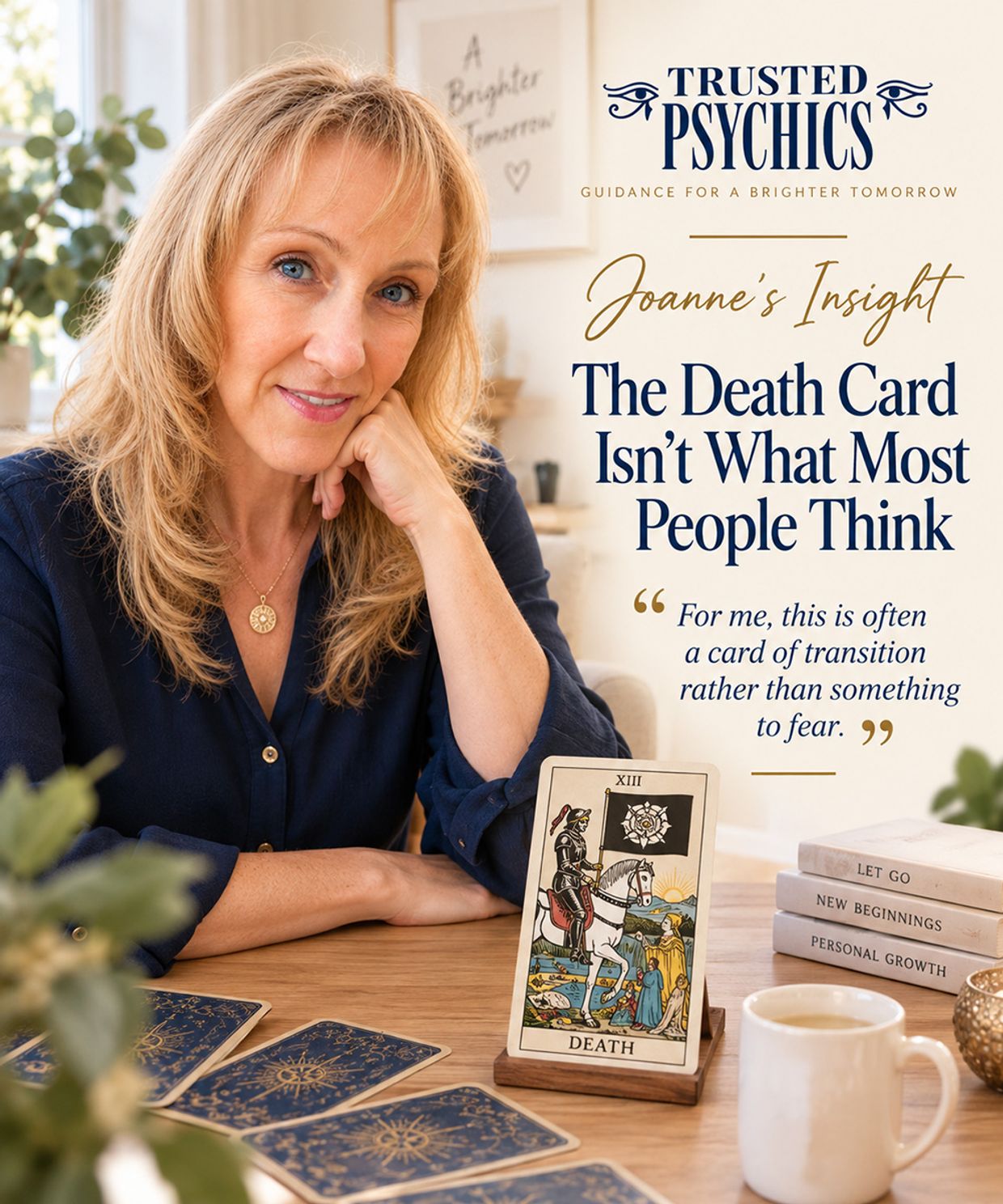
The Death Tarot card represents endings, transformation, release, and change. Despite its dramatic name and imagery, it is not normally interpreted as predicting literal physical death.
Death is Major Arcana XIII (13), and after more than 30 years around psychic and Tarot readings, it remains one of the cards I've seen people react to before a reader has even begun interpreting it.
The name is dramatic. So is the imagery.
But the first thing I would do when Death appears is separate the name of the card from what is actually changing in the person's life.
- Is Something Genuinely Ending?
- Is It Changing Form?
- Or Has It Already Ended, While You're Still Struggling to Release What It Used to Be?
Those can be three very different interpretations of the same card.
Sometimes Death represents the end of a relationship, job, habit, expectation, or phase of life.
Sometimes the situation itself isn't ending at all. Instead, the way it has existed until now can no longer continue.
And sometimes Death appears when the ending has already happened. The challenge then isn't predicting what will end. It's understanding what you're still carrying afterwards.
Since founding Trusted Psychics in 1992, I've seen how easily an intimidating card can dominate somebody's attention. With Death, I think the first responsibility is to take some of the fear out of the name.
Don't decide what Death means from the word “Death”.
Look at the question.
Look at the cards surrounding it.
And, most importantly, look at what is actually happening in the person's life.
Death Tarot Card Meaning at a Glance
| Area | Death Upright | Death Reversed |
|---|---|---|
| Core Meaning | Ending, transformation, transition. | Resistance to change or stalled transformation. |
| Relationships | A relationship or its dynamic is changing. | Difficulty releasing old patterns. |
| Feelings | Emotional transition or changing feelings. | Holding onto previous feelings or resisting emotional change. |
| Career | A professional chapter or direction is changing. | Fear of making a necessary change. |
| Personal Growth | Release, closure and renewal. | Stagnation or fear of letting go. |
| Spirituality | Transformation and changing beliefs. | Resistance to personal or spiritual development. |
| Advice | Recognise what is changing. | Examine what you're resisting. |
| Card Number | XIII — 13 | XIII — 13 |
| Zodiac Association | Scorpio | Scorpio |
Death is traditionally associated with Scorpio and the element of Water. Common themes include endings, transition, transformation, release, renewal, and the movement from one phase into another.
“One of the mistakes I've seen readers make when Death appears is deciding what the card means before interpreting the rest of the spread. The question, position, surrounding cards, and circumstances of the reading can completely change where my interpretation goes.” Joanne, Trusted Psychics.
Does the Death Tarot Card Mean Actual Death?
No. The Death Tarot card should not normally be interpreted as predicting physical death.
I want to make that distinction very clearly because the name of this card can understandably be intimidating.
In Tarot, Death is overwhelmingly symbolic. It concerns the transition from what was towards what comes next.
Think about how many endings a person experiences during an ordinary lifetime.
A relationship ends. You leave a job you've had for ten years. Your children grow up and leave home. A friendship changes. You abandon an ambition that once mattered enormously.
Or perhaps you simply stop trying to remain the version of yourself you were five years ago.
What Does the Death Tarot Card Really Mean?
At its simplest, Death suggests that something has reached a point where it cannot continue indefinitely in exactly the same form.
That doesn't automatically make the card negative.
Imagine drawing Death while asking about your career.
It could represent leaving your job.
But it could just as easily reflect a major change in responsibilities, ambitions, or your attitude towards work.
The same principle applies in a relationship love reading. Perhaps the relationship really is ending. Perhaps an unhealthy dynamic within it needs to end.
Or perhaps the relationship has reached a stage where it must evolve if it is going to continue.
Those aren't interchangeable interpretations.
This is why I don't think an important card such as Death should be interpreted in isolation.
The question matters.
The position within the spread matters.
The surrounding cards matter.
And what is actually happening in your life matters.
For me, Death is a transformation card before it is a prediction card.
How I Interpret Death: Ending, Transformation and Release
When Death appears in a reading, I find it useful to separate its meaning into three stages:
Ending → Transformation → Release
This prevents every appearance of Death from being reduced to:
“This is over.”
Sometimes that will be relevant.
Often, there's considerably more to understand.
Ending: What Has Reached the End of Its Current Form?
The first question I would ask is:
“What has actually reached the end of its present form?”
Notice that this isn't quite the same as asking:
“What am I going to lose?”
Perhaps a relationship has genuinely run its course, but perhaps it is the way two people communicate that cannot continue.
Maybe the job isn't ending, but your role within it is changing.
Perhaps you don't need to abandon an ambition completely, but your original idea of what success should look like no longer fits.
Death asks us to identify what the ending actually applies to before assuming that the whole situation must disappear.
Transformation: Does It Need to End, or Does It Need to Change?
This is the part of Death I think is most frequently overlooked. An ending and a transformation aren't always the same thing.
A couple may have reached the end of one stage of their relationship without reaching the end of the relationship itself.
A career may need to change direction without being abandoned.
An old way of responding to conflict may need to disappear while the connection remains.
Particularly in relationship readings, I would ask:
“Is the relationship ending, or is the way you've been having the relationship ending?”
Release: What Are You Still Carrying After the Change?
The third part becomes important when the ending has already happened.
You can leave a relationship and still carry the relationship with you.
You can change jobs while continuing to define yourself by the old one.
You can decide that a particular pattern isn't good for you and still find yourself repeating it.
The external ending may have happened months ago.
Internally, you may still be negotiating with it.
When Death appears in this context, I would ask:
“What am I still carrying from something that has already changed?”
Release doesn't require pretending something never mattered.
It means recognising when something no longer belongs in your present in quite the same way.
Ending → Transformation → Release makes Death considerably more useful than simply treating it as the Tarot card of endings.
What I Look at First When Death Appears
When Death appears in a spread, I don't immediately assume that something is ending.
I look at where Death has appeared, what the person actually asked and, importantly, which cards are sitting around it.
When the Death card appears in a tarot reading and the client is told it has shown itself most clients immediately make up their mind something is wrong, but if you have death surrounded by cards of healing or talking things out maybe I will take it in a different direction.
I believe it’s the readers responsibility to explain the possibilities associated with the Death card such as renewed communication, changes in the relationship, healing, or new directions.
These are the questions I will ask myself when death comes up.
For me, that's the difference between knowing the textbook meaning of Death and interpreting this Death card, in this position, for this particular question.
The Most Common Mistake I See With the Death Card
One of the easiest mistakes to make with Death is making the card bigger than the question that was asked.
If someone asks you a question about their work project and you pull death.
You could easily jump to the assumption that they are going to get fired from their job.
Maybe their work project is coming to an end or will be taking a different turn.
I always like to figure out what aspect of their life you are dealing with before I come to a conclusion on what death is telling me.
A dramatic card doesn't automatically require the most dramatic interpretation.
Death Tarot Card Upright Meaning
When Death appears upright, a significant transition may be underway or approaching.
Sometimes you already recognise it.
Perhaps you've remained in a situation longer than you wanted because leaving felt frightening. Maybe an old relationship pattern has become impossible to ignore. Your priorities may have quietly changed and the life you once imagined no longer fits the person you've become.
The upright Death card asks you to acknowledge that something is changing rather than assuming everything can remain exactly as it was.
This is where describing Death only as an “ending card” becomes too simplistic.
But the deeper meaning concerns transition. Something is moving from one state into another.
So rather than immediately asking:
“What am I going to lose?”
I would return to:
“What has reached the end of its present form?”
The answer may be much more specific, and considerably less frightening, than the name of the card initially suggests.
Death Tarot Card Reversed Meaning
Death reversed commonly represents resistance to change, difficulty letting go or a transition that has become stalled.
Part of you may understand that something isn't working anymore while another part desperately wants everything to remain familiar.
You might stay emotionally attached to an old relationship, repeat the same pattern or postpone a difficult decision due to being indecisive about the outcome.
But I wouldn't interpret resistance as weakness.
Change can be uncomfortable precisely because we don't always know what replaces the thing we're being asked to release.
Familiarity can feel safer than uncertainty even when the familiar situation is no longer making us happy.
There is another possibility too.
Sometimes reversed Death appears when the change has already happened externally, but somebody hasn't emotionally caught up with it.
When Death appears reversed, I therefore find this question more useful than assuming something bad is coming:
“What am I holding onto, and why?”
Death Tarot Card Meaning in Love
The Death Tarot card appearing in a love reading usually indicates significant relationship change. It is also one of the easiest cards to misread.
Someone sees Death beside a question about their partner and immediately thinks:
“We're going to break up.”
Sometimes a relationship does end when Death appears. But that's not the only interpretation.
Relationships continually change form. The honeymoon stage ends or living arrangements may change. Couples may become parents and priorities shift. People grow at different speeds and old disagreements eventually have to be dealt with rather than repeatedly revisited..
Death can therefore represent the end of the relationship or the end of a particular way of relating to one another.
Those are very different things.
Imagine a couple who still want to be together but have spent years dealing with disagreements in exactly the same destructive way.
The relationship itself may not need to end, but the pattern might.
That brings me back to one of the most important questions I use with this card:
“Is the relationship ending, or is the way you've been having the relationship ending?”
Our guide to Love Tarot Readings explains how relationship questions can be explored using the wider spread rather than relying on one card in isolation.
Does the Death Card Mean My Relationship Is Over?
Not necessarily.
If a relationship is already deteriorating and the surrounding cards reinforce closure, Death may reflect separation or acceptance that the connection has run its course.
But in another relationship, Death may indicate that something within the partnership needs to change.
Maybe the balance between the two people has shifted. A pattern that worked five years ago may no longer work now.
One card shouldn't frighten somebody into making a life decision.
Tarot can offer another perspective or a love psychic reading. The decision about whether to stay in or leave a relationship remains yours.
Death Reversed in Love
When Death appears reversed in a love reading, it can indicate resistance to a relationship change that somebody already knows is needed.
That doesn't automatically mean resisting a breakup, sometimes the relationship needs to change rather than end.
Imagine two people who repeatedly return to the same argument. They apologise, things settle down, and then the same pattern appears again because nothing underneath it has actually changed.
Death reversed may symbolically ask whether both people are trying to preserve the relationship without changing the behaviour that keeps damaging it.
For somebody who is single, it may instead suggest that an old relationship or experience is still shaping how new connections are approached.
Again, I would return to:
Ending → Transformation → Release.
What actually ended?
What needs to change?
And what from the past are you still carrying into the present?
Death Tarot Card as Feelings
When Death appears in a feelings position, it can symbolise emotional transition.
Someone's relationship with a connection may be changing. That doesn't automatically translate to: “They don't love me anymore.”
Someone can still care while recognising that a relationship needs to change.
They may be trying to detach after a difficult period. Their expectations could have shifted. Perhaps they're releasing old resentment and becoming more open to relating differently.
Equally, Death can sometimes symbolise feelings that really are coming to an end.
The context helps determine which interpretation fits.
Tarot cannot independently establish another person's private thoughts or feelings as fact.
If Death appears in response to:
“How do they feel about me?”
I would interpret it as symbolism around changing emotions, expectations, attachment, detachment, or emotional transition rather than claiming access to somebody else's mind.
Instead of asking only:
“Do they still love me?”
Death introduces another useful question:
“What appears to be changing emotionally within this situation?”
Death Tarot Card After a Breakup
After a breakup, Death can feel remarkably literal in its symbolism without referring to literal physical death.
A chapter has ended, but the card isn't only about the moment of separation. It can also represent what happens afterwards.
You begin accepting what happened. You grieve not only the relationship but perhaps the future you expected it to have. Familiar routines change, your identity may feel different and eventually, you begin discovering who you are outside that partnership.
This is where the Release part of my interpretation becomes particularly relevant.
After a relationship ends, it's easy for every question to remain focused on the other person.
Are they thinking about me?
Death can turn the question towards what the experience has left with you.
Something can have mattered enormously and still no longer belong in your present.
Death Tarot Card and Reconciliation
Death is not automatically a reconciliation card.
If you're asking whether you and an ex could get back together, I think its message is more useful than a simple yes or no:
If the problems that ended it are still there, returning may simply recreate the same result.
So , Death raises practical questions.
- Have the behaviours that contributed to the breakup genuinely changed?
- Have both people grown?
- Has anything actually been understood?
Are you considering returning because the relationship could now function differently, or simply because being apart hurts?
This is where Transformation matters.
Reconciliation may restore contact. Transformation asks whether the relationship itself would actually be different.
Our guide to Tarot Cards for Reconciliation looks more broadly at cards traditionally associated with reconnecting, healing, reconsideration and second chances.
If your underlying question is whether a previous relationship could return, Will My Ex Come Back? explores that question more broadly rather than treating one Tarot card as a guaranteed answer.
Death Tarot Card for Singles
When Death appears for somebody who is single, my attention isn't immediately drawn towards who might be coming next.
Perhaps you're finally releasing an ex.
Maybe you're recognising a pattern in the people you've previously chosen.
Perhaps the qualities you once wanted from a partner don't appeal to you anymore.
Or you may be recognising something about your own behaviour within relationships that you don't want to repeat.
Sometimes the most important romantic transformation happens before another relationship begins.
What Does the White Horse Mean on the Death Tarot Card?
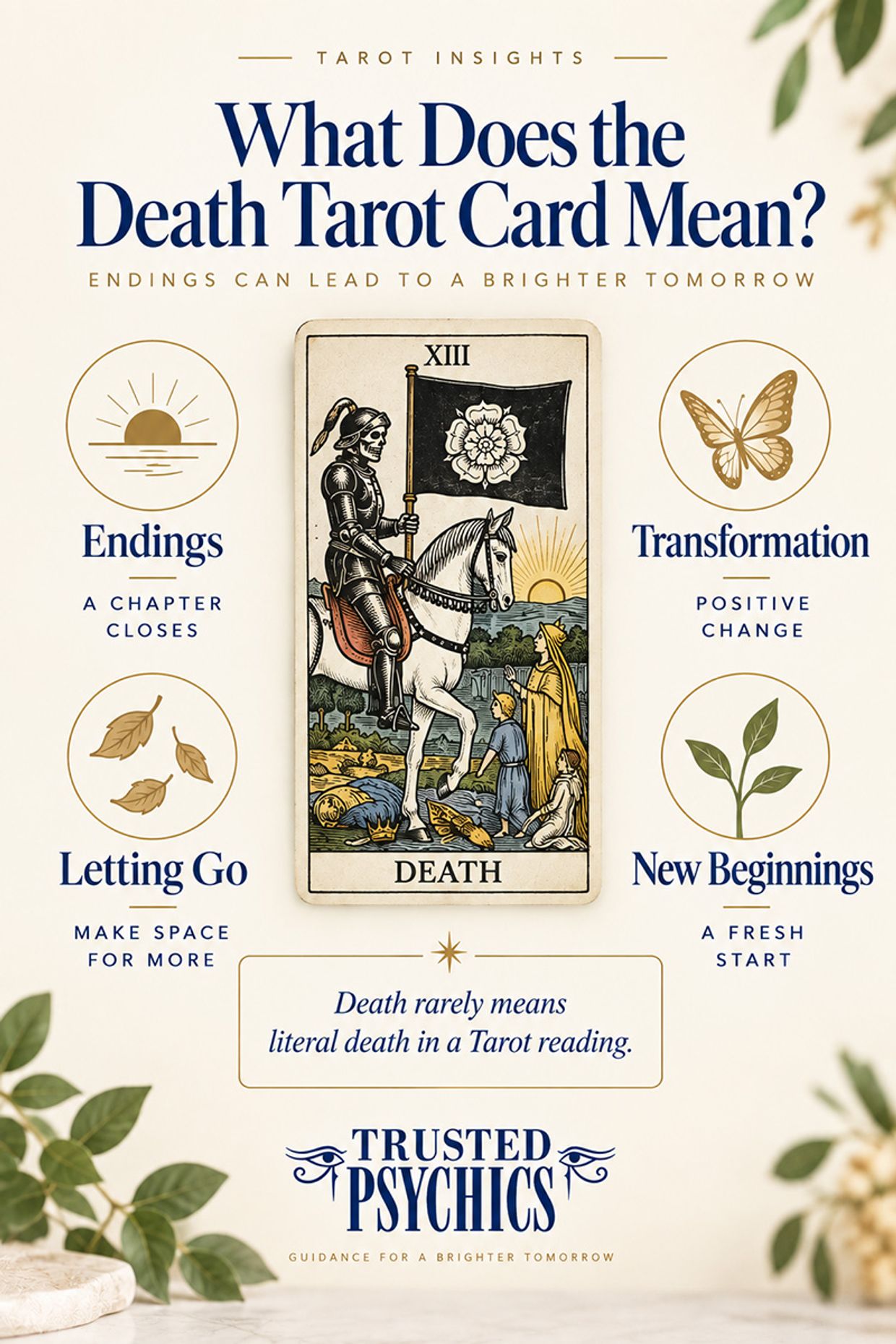
On the Rider-Waite Smith death card you will see that the skeleton is riding a white horse.
White can be symbolic of many things but often it's known to represent purity and clarity which makes sense to have on this card.
However, I believe it plays another factor into the card. It allows us to understand that the horse is going somewhere.
Which I think goes hand and hand with the meaning of the death card. It’s not meant to sit at an end forever. When something cannot be kept the same, we have to allow change to happen.
You can understand that something is coming to an end and life doesn't just stop there.
When looking at the horse on this card you should ask yourself what is changing. Not just what is ending but where do you want to go from here.
What Does the Black Flag and White Rose Mean on the Death Tarot Card?
The skeleton holds a black flag with a white rose, black fits perfectly with death being associated with endings and things that we don't know about.
The white rose gives another message, one of life and freshness.
What I believe is key here is that they both are shown together.
Death can be a scary thought but this card shows you that it isn't all that.
You see the white rose on top of all that darkness. There can be an ending to something and something new on the horizon.
Just because something is coming to an end doesn't mean that the white rose isn't also there.
Death's Place in the Major Arcana Journey
When we look at where death falls in the Major Arcana it gets more intriguing. It’s the 13th Major Arcana card. Sits between the Hanged Man (XII) and Temperance (XIV).
The Hanged Man - Death - Temperance
The Hanged Man- stopping and gaining perspective on something.
Death- death and transition.
Temperance- learning to adapt and come to terms with your new normal.
The Hanged Man can represent the stage where you stop, reconsider and begin looking at a situation differently.
And then you have Temperance. Something has transitioned but you must learn to live with it.
I find this interesting because it can help you understand why Death should not stand alone.
Pause → Transformation → Adjustment.
Maybe you go through this after ending a relationship. You question and rethink things. Then the relationship ends or fundamentally changes.
You will get accustomed to adjusting to the life you live now. The same pattern can appear around careers, friendships, beliefs, and personal identity.
Death Vs Ten of Swords: What's the Difference?
Death and the Ten of Swords can both show up near an ending but I don't think they can be used interchangeably.
Usually, the Ten of Swords will bring focus to the end. Something may feel burnt out. Ended or you can’t see how it will continue.
Death will look past the end and into what the change will be. Because it can’t go on.
I like to think of it this way.
Ten of Swords = It's over.
Which can come in handy if you’re doing a relationship or work spread.
You can see that the Ten of Swords will show that something has ended. Whereas Death will take the focus to letting go and what needs to be changed.
Death Tarot Card Combinations
The card beside Death can help identify what kind of transformation the spread may be describing. The question asked, the spread positions and remaining cards still determine which interpretation is more accurate.
Death With the Tower
Death with The Tower can intensify themes of significant change. The Tower introduces disruption while Death emphasises the transition that accompanies or follows it.
"I do not automatically predict disaster; I try to explore may be disrupted and what transformation follows because of it."
Death With the Star
Death with The Star can create a very different progression. Here, an ending or transformation sits beside themes traditionally associated with hope, renewal and looking forward.
My thoughts are drawn to significant change, with The Star offering a sense of direction towards what may come next.
Death and the Lovers
Death with The Lovers may introduce significant change within a relationship, relationship choice, or personal values. It doesn't automatically predict separation.
If I saw these two cards appear together in a love reading, I would look deeper into what could be changing in the relationship.
Death With the Devil
Death with The Devil can draw attention towards breaking an unhealthy attachment, dependency, or repeated behaviour. Maybe the jealousy, resentment, dependency or habits you have with one another need to change.
Death is telling us that this won’t go on forever in the same manner. Sometimes it’s not the person we want to let go of. But the habit we've built around them.
Death With the Fool
Death with The Fool creates one of the clearest ending-and-beginning narratives. One phase may close while another becomes possible.
What I like about this spread is that you don't always know what's going to come after something ends. But there is room to explore and try again.
Death and Judgement
Death with Judgement may connect transformation with reassessment, recognition and deciding that an old version of something no longer belongs in the future.
Something you accepted no longer aligns with who you are. Judgement could allow us to realise what we learned from the past.
The question, spread positions and remaining cards still determine which interpretation makes sense.
Death and the Hanged Man
Death with The Hanged Man can suggest a time of waiting where things may be uncertain and we are unsure which direction to proceed on.
The Hanged Man can appear before the change is about to happen, when instead of following the same path, it may be wise to reconsider and look at different possible outcomes.
Often change can cause anxiety even when our intuition tells us it’s the right choice to make. So, I always ask in a reading what changes in your life would make things seem more fulfilling.
Death and Temperance
Since Death and Temperance are adjacent cards in the major arcana this can be a great flow.
You can have a change and then learn to live with it. Death is your change and temperance is learning how to accept and adapt.
If someone thinks they will instantly feel better or comfortable after something ends this would be good to keep in mind.
Things can end overnight and take a long time to come to terms with.
Death and Six of Cups
When Death is paired with the Six of Cups. We can start to bring up past events/nostalgia/old relationships etc. Just because you remember something from the past doesn't mean you want to be there. Maybe you’re thinking of a past relationship because you loved it.
Remembering something and wanting to go back to it are two different things.
Death and Eight of Cups
This combo can also bring about more of the leaving theme. Death can amplify your journey away from something or someone.
Eight of Cups will teach you to walk away from something. Sometimes you just have to understand that loving something isn't enough to make it work.
Always remember that these combos are not one size fits all. You will need to use the question, position in your spread and other cards to find your answer.
Tarot Death Meaning in Career
In a career reading, Death points towards professional transition. For one person, that may genuinely mean leaving a job.
For somebody else, it could represent changing responsibilities, completing a long-term project, abandoning an old ambition, or recognising that their definition of success has changed.
Drawing Death doesn't mean: “Go into work tomorrow and resign.”
Instead, consider what part of your professional life may have reached a natural turning point.
I've seen how people can spend years progressing towards something and eventually discover that achieving it doesn't feel the way they expected.
It may simply mean the person who originally chose the destination has changed. If you've become increasingly disconnected from your job, what has changed?
Tarot can help structure those questions. Important career and financial decisions should still be made using practical information and appropriate professional advice.
Death Tarot Card Spiritual Meaning
Spiritually, Death has long been associated with release, renewal, and personal transformation. But transformation doesn't always have to look dramatic.
Sometimes it's realising that an old belief no longer makes sense to you.
Sometimes it's forgiving something. Perhaps your priorities change. Or you simply become comfortable admitting that you've changed your mind.
We often think personal growth means continually adding something to ourselves.
More knowledge.
More confidence.
More experience.
Death introduces the opposite possibility.
Growth can also involve subtraction.
That leads to one of my favourite questions within the card:
“What happens when you stop carrying something that no longer belongs to you?”
Symbolism of the Death Tarot Card
The traditional Rider-Waite-Smith Death card is deliberately confronting.
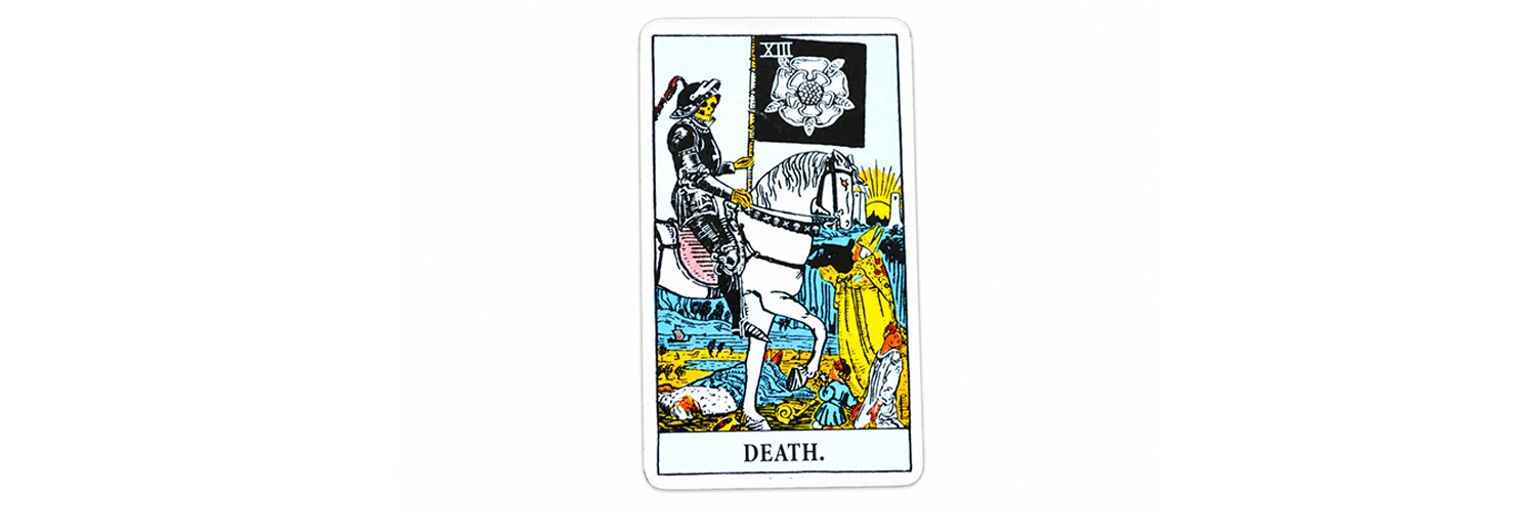
A skeleton in black armour rides a white horse. Figures respond to its arrival. A white rose appears against the dark imagery, while in the distance a sun rises between two towers.
There is considerably more happening here than the card's name initially suggests.
The imagery contains death and life, endings and continuation, darkness, and light simultaneously.
For me, that contradiction is exactly why the card works so well as a symbol of transformation.
What Does the Skeleton Mean on the Death Tarot Card?
The skeleton is the image most people notice first. Symbolically, it can represent what remains when temporary things have been stripped away.
A role can change.
A relationship can change.
Circumstances can change.
An old version of your identity can change.
The skeleton therefore introduces a useful question:
“When everything else changes, what remains important?”
That can be particularly revealing when somebody has built a large part of their identity around something that is now changing.
Why Is the Sun Rising on the Death Tarot Card?
The detail I often come back to isn't actually the skeleton. It's the rising sun in the background.
Beyond the figures in the foreground, the sun appears between two towers.
The present chapter may be ending, but the landscape doesn't end with it.
I think that's one of the most important details on the card because Death can make somebody focus so completely on what is changing that they struggle to imagine anything beyond it.
The rising sun doesn't promise that whatever comes next will be better.
I wouldn't use it to tell somebody that every painful ending happens for a positive reason.
It simply reminds us that the present transition isn't the entire landscape. Life continues beyond the moment currently demanding your attention.
Death Vs the Tower Tarot Card: What's the Difference?
Death and The Tower are frequently confused because both can appear around significant periods of change.
But they don't describe quite the same experience.
The Tower is primarily concerned with disruption.
Death is primarily concerned with transformation and transition. The Tower may expose or destabilise something suddenly.
The Tower disrupts. Death transforms.
If both appear together, I wouldn't automatically assume catastrophe.
Instead, I'd look carefully at the question and surrounding cards to understand what kind of change the spread is actually describing.
Is the Death Tarot Card Yes or No?
Trying to force Death into a simple yes-or-no answer loses much of what makes the card useful.
If I had to reduce its message, I would be more inclined to say:
“Something needs to change.”
If your question is:
“Will everything remain exactly as it is?”
Death naturally leans away from that outcome.
If you're asking:
“Can this situation change?”
But complicated questions about relationships, careers and major life choices rarely benefit from being reduced to one word.
Death Tarot Card in Past, Present and Future Positions
Death in the Past Position
When Death appears in the past, it may represent a previous ending or transformation that continues to influence your current situation.
The useful question is whether you've genuinely moved through that transition or are still carrying part of it forward.
Death in the Present Position
In the present, Death can suggest that transformation is happening now.
You may be actively letting something go, or perhaps you've simply reached the point where change is becoming increasingly difficult to avoid.
Death in the Future Position
In the future, Death should not be interpreted as a prediction of literal death or inevitable disaster.
Is the Death Tarot Card Positive or Negative?
I don't think “positive” or “negative” is particularly useful here.
An ending can hurt and still be necessary. Change can be wanted and still frightening. A relationship can transform for the better.
Another relationship may end because the two people involved no longer want the same things.
Death doesn't promise that something wonderful will happen simply because something painful happened first.
Its message is more grounded:
Things change.
The important question is what the change actually means in the context of your life.
Death Tarot Card and Scorpio
Death is traditionally associated with Scorpio, a Water sign often connected in astrology with intensity, depth, transformation, and renewal.
That correspondence fits naturally with Death's central themes.
Both are associated symbolically with processes that go beneath the surface rather than remaining superficial.
But the Scorpio correspondence is an additional layer rather than a complete explanation of the Tarot card.
Death remains Major Arcana XIII and should still be interpreted according to its position, question, and surrounding cards.
If you'd like to understand the astrological association more deeply, our Scorpio Personality Traits guide explores the qualities traditionally associated with the sign.
How Trusted Psychics Approaches the Death Card Responsibly
Of all the Tarot cards, Death is one where responsible interpretation matters enormously.
A reader shouldn't tell somebody that Death predicts their physical death.
It shouldn't guarantee that an ex will return after a transformation.
And an intimidating card should never become a reason to pressure somebody into purchasing repeated readings.
Trusted Psychics has been connecting customers with psychic and Tarot readers since 1992. Today, customers can choose from 400 experienced readers, with individual profiles explaining their abilities, tools, specialisms, and reading styles.
Some readers work predominantly with Tarot, while others combine Tarot with psychic, clairvoyant, mediumship, or intuitive abilities.
Our telephone service is available 24 hours a day, and Psychic Messenger provides another way to connect with a reader.
If Death has appeared within a spread and you'd like to explore the wider context, you can compare individual reader profiles before deciding who feels most appropriate for you.
Death Tarot Card FAQs
Is the Death Tarot Card a Bad Card?
Not necessarily. It just means something may be ending. Or transforming/ transitioning. Or letting go of something.
How that may or may not feel positive will depend on your question and the surrounding cards.
Death can seem scary because of the image on the card. But there is so much more to learn from this card than "I'm going to die."
Does the Death Tarot Card Mean a New Beginning?
Yes, it can. However, I believe there is a fine line here. The death card is usually about the ending/ transformation of something.
Once that has happened. It can open the doors for a new beginning.
Which is why I don't always default to.
"Your life is about to get better." Some things take time to come after an ending.
You have a sun rising and a white rose which do represent that but. Not everything has to be sunshine and rainbows right away.
Why Do I Keep Pulling the Death Tarot Card?
Repeatedly drawing Death can symbolically emphasise a theme of change, release or transition that remains relevant to the question you're exploring.
It doesn't mean that something increasingly terrible is approaching. Instead, consider whether you're repeatedly returning to a situation without addressing what has already changed, or what may need to.
Ending → Transformation → Release framework can be particularly useful here.
What Zodiac Sign Is Connected to the Death Tarot Card?
Death is traditionally associated with Scorpio, a Water sign connected in astrology with themes including depth, transformation, and renewal.
The astrological correspondence adds another symbolic layer to Death rather than replacing the card's wider Tarot meaning.
What Number Is the Death Tarot Card?
Death is Major Arcana XIII, or card number 13.
Despite cultural superstitions around the number 13, the card's Tarot meaning centres primarily on endings, transformation, transition, and release.
What Card Comes Before Death in Tarot?
The Hanged Man, Major Arcana XII, comes immediately before Death in the traditional Major Arcana sequence.
There is an interesting symbolic progression between them. The Hanged Man is traditionally associated with pause, surrender and seeing something differently.
Death then introduces transition and the recognition that something cannot remain in its previous form.
What Card Comes After Death in Tarot?
Temperance, Major Arcana XIV, follows Death.
Symbolically, that progression can be interesting because Death introduces transformation while Temperance is traditionally associated with balance, integration, and adjustment.
Something changes. Then comes the process of learning how to live with what has changed.
What Does the White Rose on the Death Tarot Card Mean?
The white rose on the Rider-Waite-Smith Death card is traditionally associated with purity, renewal, and life.
Its presence within otherwise dark imagery helps show why Death isn't interpreted solely as destruction.
The card contains imagery of ending and continuation at the same time.
Why Is There a Rising Sun on the Death Tarot Card?
A rising sun appears in the background of the Rider-Waite-Smith Death card.
It is commonly associated with continuation, renewal and what exists beyond the present transition.
For me, its position is particularly important.
The ending occupies the foreground.
But it isn't the entire landscape.
Why Is Death Card Number 13?
Death is traditionally numbered XIII, or 13, in the Major Arcana.
Although 13 has acquired negative or unlucky associations in some cultures, the Tarot card itself isn't simply a symbol of bad luck.
Its position within the Major Arcana places it between The Hanged Man and Temperance, creating a sequence that moves from pause and altered perspective through transformation and then towards adjustment and integration.
Final Thoughts From Joanne Jones
I don't think we need to turn every difficult experience into a positive one for it to have meaning.
Instead, Death asks us to recognise when something cannot remain exactly as it was.
Then we can begin asking what the transformation actually applies to.
Does the whole situation need to end?
Does part of it need to change?
Or has the ending already happened, leaving you with the more difficult task of deciding what you no longer need to carry?
Then:
For me, that's where Death becomes considerably less frightening and considerably more useful.
The question isn't simply what is ending. It's what you choose to carry forward when it does.
— Joanne Jones, Founder of Trusted Psychics
About Trusted Psychics
Our telephone psychic reading service is available 24 hours a day, and customers can also use Psychic Messenger.
Trusted Psychics believes Tarot readings should offer perspective rather than make decisions for customers. We don't support guaranteed predictions, fear-based readings or claims that remove personal choice.
Related Articles
Tarot Card Meanings: All 78 Tarot Cards Explained
The High Priestess Tarot Card Meaning
The Wheel of Fortune Tarot Card
How To Contact A Trusted Psychic
Phone a live Psychic 24 hours a day
View all our live phone psychic and tarot readers online.
View All Live readersMessage a live Psychic 24 hours a day:
View all our live messenger psychic and tarot readers online.
launch messenger
Recent Articles From the Trusted Psychics Blog

Judgement Tarot Card Meaning
Discover Judgement Tarot card meanings for love, reconciliation and second chances. Explore upright, reversed, feelings, career and spiritual interpretations.

Tarot Cards for Beginners
Learn how to read Tarot cards with Joanne Jones. Follow 8 easy steps for beginners, understand card meanings, practise Tarot spreads, and build confidence.

3 Card Career Tarot Spread
Learn how to use a 3-card career Tarot spread with Joanne Jones. Explore card meanings, job opportunities, and career choices with a practical worked example

The High Priestess Tarot Card Meaning
Discover the High Priestess Tarot card meaning in love, feelings, upright and reversed readings, with Joanne Jones' insights, symbolism, and card combinations.

Tarot Card Meanings: All 78 Tarot Cards Explained
Discover the meanings of all 78 Tarot cards, including Major and Minor Arcana, upright and reversed meanings, suits, Court Cards and expert interpretation.

Top 10 Tarot Readers UK
Meet our Top 10 Tarot Readers in the UK. Compare experience, reading styles, specialisms and verified profiles to find a trusted Tarot reader in the UK.