

To pay for your reading on your telephone bill, simply call
Instantly message our featured psychics online via psychic messenger.
Click to start
Register now to start your reading online. PSYCHIC MESSENGER- Cheapest psychic service in the UK
- Our readers are available 24/7
- 100% confidential service
- In-depth, concise, personal readings
- Thousands of 5* reviews
Published 07/02/2023 • Updated 25/09/2026 by Joanne Jones
The Hermit Tarot Card Meaning
Written by Joanne Jones - Psychic Medium, Astrologer & Founder of Trusted Psychics | 30+ Years' Experience
The Hermit Tarot card represents Introspection, solitude, inner wisdom, reflection, and the search for greater understanding.
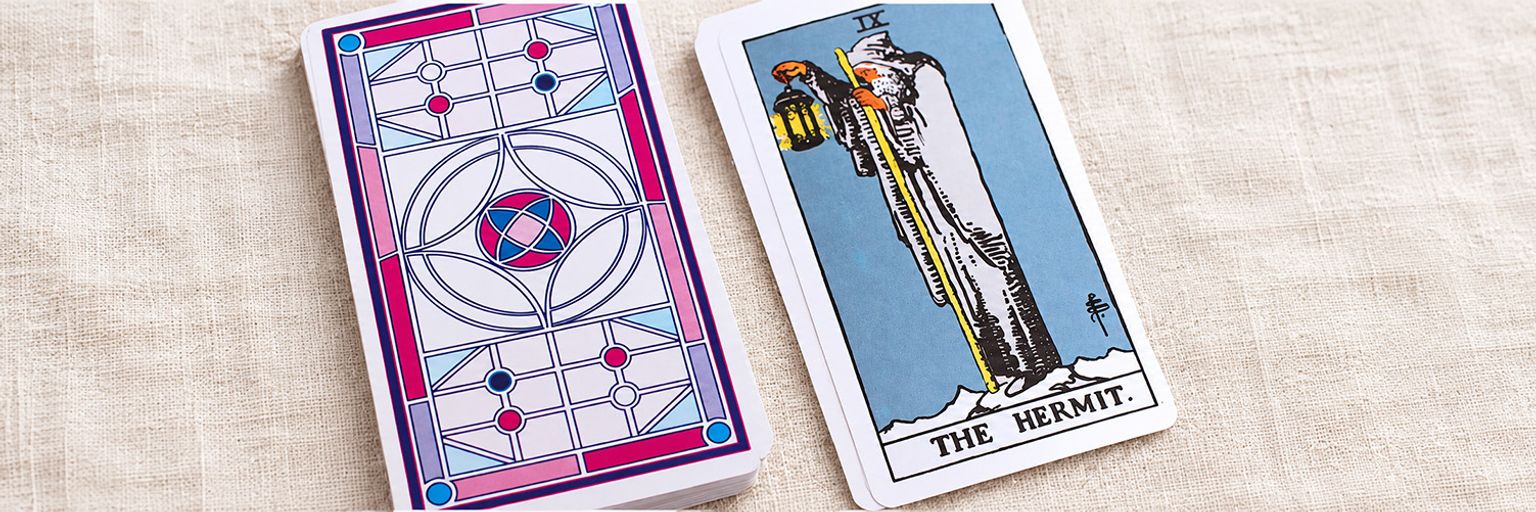
It is Major Arcana IX (9). Traditional imagery shows a solitary figure standing on a mountain holding a lantern and staff. Rather than illuminating everything around him, the lantern casts enough light to see only part of the path ahead.
That image captures one of The Hermit's most important meanings: you do not always need to see the entire journey to understand your next step.
Upright, The Hermit commonly represents deliberate solitude, reflection, seeking wisdom and stepping away from outside noise long enough to understand what you actually think or want.
Reversed, it can suggest that useful solitude has become isolation, that someone is withdrawing too far, or conversely that there hasn't been enough space for necessary reflection.
In love, The Hermit can represent independence, emotional space, or a period of reflection within or outside a relationship. As feelings, it can symbolise private, introspective, or difficult-to-express emotions, but it cannot establish another person's private thoughts as fact.

The Hermit Tarot Card Meaning at a Glance
| The Hermit | Traditional Meaning |
|---|---|
| Card Number | IX — 9 |
| Arcana | Major Arcana |
| Upright | Introspection, solitude, wisdom, reflection, inner guidance |
| Reversed | Isolation, withdrawal, loneliness, avoidance, or resisting reflection |
| Love | Space, independence, reflection, emotional distance |
| Feelings | Private, reflective, or difficult-to-express emotions |
| Career | Reassessment, independent work, research, expertise |
| Spirituality | Inner wisdom, contemplation, self-discovery |
| Yes or No | Usually maybe / pause and reflect |
| Zodiac Association | Virgo, Mercury |
Joanne's interpretation: “For me, The Hermit isn't simply the card of being alone. It's about creating enough quiet to understand what you really think and feel.”
What Does the Hermit Tarot Card Mean?
The Hermit is the Tarot card of stepping back in order to see more clearly.
That distinction matters.
Being alone and being lonely are not the same thing, and neither are reflection or avoidance.
The Hermit traditionally represents a purposeful withdrawal from noise, distraction, or other people's opinions so that something can be considered more carefully.
Sometimes we look for answers by gathering more information; we may ask people or search for other people’s opinions or replay a situation in order to try and fully understand its meaning.
The Hermit introduces the opposite possibility: perhaps what is needed isn't another voice; perhaps it is enough quiet to hear your own.
That is why during a tarot reading this card can appear symbolically around major decisions, periods of transition, questions of identity, relationships, career direction, or spiritual exploration.
The Hermit does not necessarily provide an immediate answer; it creates space for an answer to become clearer.
Why Is the Hermit a Major Arcana Card?
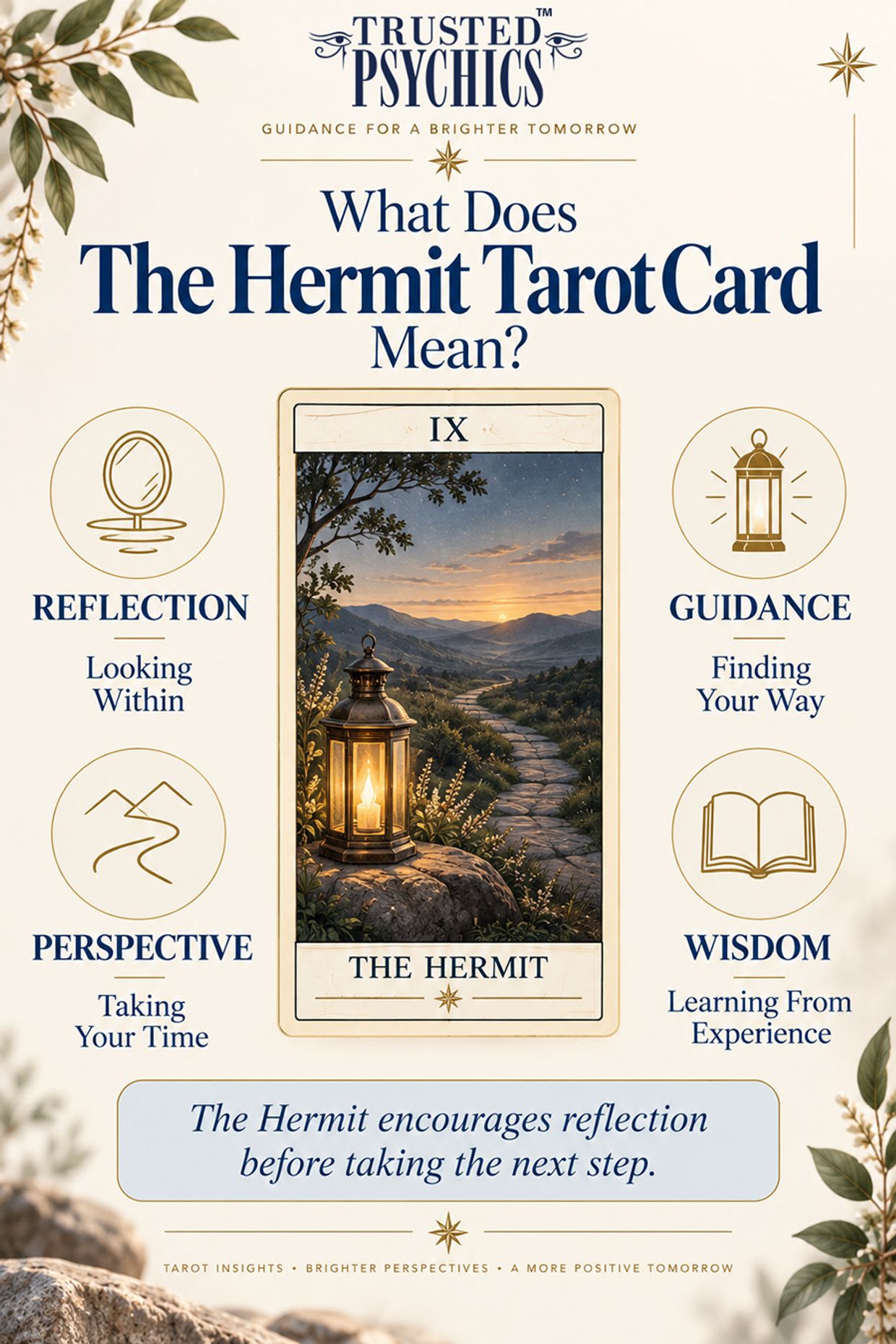
The Hermit is the 9th card of the Major Arcana. There are 22 cards that make up the major arcana in a tarot deck.
Most people believe that the major arcana cards represent greater life lessons. They are usually focused on your growth as a person or a time in your life where you will experience growth or enlightenment.
Many times, we hear the Hermit card being interpretated as a negative card to appear in a tarot card reading when often this is not the case. We spend much of our lives in a constant rush whether it’s our work or home life and very often we do not allow ourselves the time to relax and unwind. When you receive the hermit as a message it could be telling you that you need to spend more time alone but not just because you’re busy or need time to yourself.
The hermit falls after the card of Strength and before the wheel of fortune. This tells us that after learning how to become stronger we need to take time to reflect on our lives before moving onto the next stage of our journey which is the wheel of fortune.
The Hermit Tarot Card Keywords
Upright keywords commonly associated with The Hermit include Introspection, solitude, reflection, wisdom, contemplation, inner guidance, self-discovery, independence, patience and searching for truth.
Reversed meanings can include isolation, loneliness, excessive withdrawal, avoidance, disconnection, refusing support or resisting necessary self-reflection.
These are traditional interpretive themes rather than fixed meanings.
The question, spread position and surrounding cards help determine which aspects of The Hermit are most relevant.
The Symbolism of The Hermit Tarot Card
In the Rider-Waite-Smith tradition, The Hermit card depicts an older robed figure standing alone on a mountain. In one hand he holds a lantern containing a six-pointed star. In the other is a staff.
“The landscape is sparse. There is no crowd around him and no brightly illuminated destination ahead. The Hermit's journey is one of genuine solitude”.
The most interesting symbol may be the lantern, as it does not light the entire mountain; it illuminates only what is close enough to see.
Every part of that imagery contributes to the traditional interpretation.
Symbol Traditional Interpretation
| Symbol | Traditional Interpretation |
|---|---|
| Lantern | Wisdom, guidance, and enough light for the next step |
| Six-pointed star | Insight, illumination, and spiritual wisdom |
| Staff | Support, experience and stability |
| Mountain | Achievement, perspective, and the journey towards understanding |
| Grey Cloak | Simplicity, withdrawal, and reduced distraction |
| Solitary Figure | Introspection and deliberate independence |
| Darkness | What remains unknown or unexplored |
What Does the Lantern Mean in the Hermit Tarot Card?
The lantern is one of the clearest symbols of The Hermit.
It represents wisdom and guidance, but its limited pool of light is just as important as the light itself.
The Hermit cannot see everything. He can see just enough to continue.
In a tarot reading, this can symbolise situations where complete certainty isn't necessary before taking the next considered step.
Perhaps you don't know exactly where a career change will eventually lead.
Perhaps you haven't resolved every feeling about a relationship.
Perhaps a period of personal reflection has answered one question while creating three more.
The Hermit's lantern suggests that insight can arrive gradually; you don't necessarily need a floodlight.
Sometimes a small amount of genuine clarity is more useful.
What Does the Mountain Mean in the Hermit?
The Hermit stands high on a mountain rather than remaining among the activity below.
Mountains traditionally suggest challenge, perspective, achievement, and distance. From higher ground, familiar things can look different.
Symbolically, this fits The Hermit's association with stepping away from immediate reactions so that a situation can be viewed more broadly.
The mountain also makes an important point about wisdom: perspective often requires effort.
The Hermit hasn't accidentally found himself at the top of the mountain; the imagery suggests a journey has already taken place.
What Does the Staff Mean in the Hermit Tarot Card?
The staff can represent support, experience, and stability.
The Hermit may be travelling alone, but he isn't without resources.
This creates another useful distinction in the card: independence doesn't have to mean rejecting all support.
You can make your own decisions while still learning from experience, listening to useful advice or accepting help when it is needed.
The Hermit's solitude is purposeful; it’s a time for reflection, and it does not require complete disconnection from everybody else.
The Hermit Upright Meaning
When The Hermit appears upright, it commonly represents a period of Introspection or deliberate withdrawal.
You may need time to think.
A decision may benefit from being considered without pressure.
You might be questioning whether something still fits your values or the direction you want your life to take. Or you may simply need a quieter period after prolonged activity or emotional intensity.
The card can also represent seeking wisdom, which may come from your own experience, careful reflection, study, a mentor, or somebody whose perspective you respect.
The important point is that The Hermit is generally purposeful rather than passive.
He isn't simply doing nothing; he is thinking, observing, and learning.
That is what separates productive solitude from merely withdrawing from life.
The Hermit Reversed Meaning
The Hermit reversed often asks whether solitude is still serving its original purpose. There is a point at which useful reflection can become isolation.
Time to think can become avoidance. Independence can become refusing help simply because it is available.
Reversed, The Hermit may therefore symbolise loneliness, excessive withdrawal, disconnection or becoming so absorbed in your own thoughts that perspective becomes harder rather than easier to find.
But reversals are not interpreted identically by every Tarot reader, as some interpretations are almost the opposite: perhaps you have avoided taking the quiet time you actually need.
Constant activity, socialising, work, social media, or just being in demand from others can prevent reflection just as effectively as excessive isolation.
The question becomes:
Do you need more space, or have you already had too much?
Context helps answer it.
Solitude or Isolation? The Most Important Difference in the Hermit
The Hermit is frequently described simply as the card of being alone.
That misses an important distinction.
Solitude can be chosen, whereas isolation can feel imposed or become difficult to leave.
Solitude can create perspective. At the same time, isolation can sometimes narrow it.
The upright Hermit commonly represents stepping back for a reason.
The reversed Hermit can ask whether that retreat has stopped being useful.
This is why the same physical behaviour, spending time alone, can carry very different meanings depending on the context of a reading.
The question isn't simply:
“Am I alone?”
A more useful question is:
“What is this time alone doing for me?”
The Hermit Tarot Card Meaning in Love
In love tarot readings, The Hermit often represents space, independence, and reflection.
For somebody in a relationship, it may symbolise a need for more individual space or time to think about what they need from the connection.
That does not automatically mean a breakup. Healthy relationships can contain independence as well as togetherness.
For somebody single, The Hermit can represent a period when understanding personal relationship patterns feels more important than actively pursuing a new connection.
It may also appear after a difficult relationship when somebody wants time to reconsider what they actually want from future relationships.
The card is therefore less about predicting whether love will happen and more about the relationship between connection and independence.
The Hermit Tarot Card as Feelings
As feelings, The Hermit can symbolise emotional uncertainty, private feelings, or emotions still being processed.
The card can also represent someone who doesn’t want to rush into a decision or say how they feel without first taking time to sort out their emotions.
If you’re wondering how someone feels about you and The Hermit comes out, they may still be figuring things out themselves. There may be some emotional reserve or Introspection about the relationship. Remember, though, that no Tarot reading can confirm someone else’s private feelings as fact.
The Hermit card is all about reflection, so sometimes it will even ask you whether you’re sure about how you feel. Are you sure you know what you want, or are you still trying to figure out your feelings about the situation?
Does the Hermit Mean Someone Is Pulling Away?
The Hermit can certainly mean that someone is pulling away from you. They may be communicating less, becoming distant, or taking a step back in the relationship.
But this doesn’t necessarily mean they are losing interest. There are many reasons someone might take a step back to think, process things on their own, or figure out what they want. The Hermit could even just be representing that you’ve noticed the relationship isn’t as connected as it once was.
The Hermit doesn’t let you know if someone is planning on leaving you or not. This means you’ll have to pay more attention to their behaviour and what they actually tell you about how they feel.
The Hermit Tarot Card Love Reversed
In a love reading, The Hermit reversed can represent emotional isolation, withdrawal or feeling alone even while technically in a relationship.
There is an important difference between maintaining independence and shutting somebody out. The reversed card may therefore raise questions about communication, vulnerability and whether space between two people has become difficult to bridge.
For somebody who is single, it can sometimes suggest that self-protection has turned into avoidance of connection.
Another interpretation is the opposite: perhaps you haven't had enough independence in a relationship, and you have neglected your own needs, so the things you enjoy doing have become secondary.
Remember that Tarot card reversals don’t always mean the complete opposite of what the card means upright. Take into consideration the question you asked and the cards around The Hermit to decide which meaning makes more sense.
The Hermit Tarot Card and Breakups
After a breakup, The Hermit can naturally represent the period of emotional time needed that often follows a relationship ending.
Distance can create room to process what happened, understand personal patterns and decide what should be carried forward, or left behind.
The card cannot tell you exactly what an ex is privately thinking or whether reconciliation will follow; its symbolism is better understood as a time for healing and often recovery from the feelings of loss you may be experiencing.
Sometimes The Hermit after a breakup is quite literally about learning what the relationship taught you when there is nobody else in the room to answer the question.
That can be valuable regardless of whether the relationship resumes.
Does The Hermit Mean an Ex Will Come Back?
Not by itself.
The Hermit is not a strong standalone prediction of reconciliation because its traditional energy is inward rather than outward.
In a tarot reconciliation spread, it might symbolise reflection, distance, unresolved questions, or a period of little external action.
The surrounding tarot cards would substantially change that interpretation.
The Hermit alongside Judgement could introduce themes of reflection and reconsideration.
The Hermit alongside the Eight of Cups might instead emphasise withdrawing in order to move on.
Neither combination guarantees what another person will choose.
The complete spread matters answer the question “Will my ex-return?”
The Hermit Tarot Card Spiritual Meaning
The Hermit has a strong traditional association with spiritual knowledge.
Its imagery does not depict somebody receiving an instant revelation.
Instead, wisdom is represented as something sought deliberately. This can make The Hermit particularly relevant to periods of questioning.
Perhaps an old belief no longer feels convincing, or maybe you are exploring a different spiritual practice.
Perhaps you are simply becoming more interested in your own values, purpose, or inner life, although the Hermit does not require one particular spiritual belief.
Its broader symbolism concerns the act of searching, and often the question itself is part of the journey.
Joanne's Professional Insight
“Over the years, I've noticed that people can see The Hermit and immediately worry that it means loneliness or somebody walking away.
For me, the more interesting question is whether the space represented by the card has a purpose.
There is a big difference between stepping back because you need to understand something and shutting yourself away because you don't want to face it.
That's why I don't think The Hermit is really about being alone. I think it's about what happens when the noise becomes quiet enough for you to hear yourself properly.”
— Joanne Jones, Founder of Trusted Psychics
Trusted Psychics has been connecting customers with psychic and Tarot readers since 1992. Individual readers may interpret The Hermit differently based on their experience, reading style, spread, and the cards surrounding it.
The Hermit Tarot Card Meaning in Career
In career readings, The Hermit can represent reassessment, independent work, research, expertise, or taking time to consider whether your current direction still suits you.
It can be particularly relevant when somebody has been following a path largely because it was expected of them.
Stepping away from immediate pressure can make it easier to ask:
- Do I actually want this?
- What am I working towards?
- What have I learned?
- What matters to me, that may not have mattered before?
If The Hermit appears in a reading, this should not be interpreted automatically as the need to change job or start a new career.
It can just as easily represent becoming more specialised, studying, developing expertise, or seeking guidance from an experienced mentor.
Its emphasis is on considered direction rather than impulsive movement.
The Hermit Tarot Card Meaning for Money
For money, The Hermit can represent a cautious and reflective approach.
Rather than suggesting sudden financial gain or loss, it may symbolically encourage reviewing spending, understand your financial priorities, or gather information before making a significant decision.
The card's slower energy suits research better than impulse.
For important decisions involving investments, debt, contracts or other financial commitments, verified information and appropriately qualified financial advice should take precedence over Tarot.
The Hermit Tarot Card as Advice
As advice, The Hermit says:
Create enough space to think clearly.
That does not necessarily mean physically isolating yourself; it might mean reducing outside opinions.
Taking the time to really think the situation through before answering.
It may be wise to seek advice from one experienced person you trust rather than ten different people.
Or simply recognising that an immediate decision isn't always necessary, as a quick response is unlikely to change the outcome.
The Hermit values considered understanding over speed.
Sometimes the next step becomes easier to see once you stop demanding to see the entire route.
The Hermit Tarot Card as a Person
When The Hermit represents a person, it can symbolise somebody who is introspective, independent, thoughtful, private, or experienced.
They may prefer smaller groups, meaningful conversations, or time alone to constant social activity.
The card can also represent a mentor, teacher, or somebody whose experience provides perspective.
Reversed, it may describe somebody who has become isolated, difficult to reach or overly resistant to outside input.
These are symbolic character themes rather than factual assessments of another person's personality.
Is The Hermit Tarot Card a Yes or No?
There is no universal yes-or-no interpretation for The Hermit.
Some Tarot readers treat it as a maybe, others as not yet, while some assign it a definite yes or no depending on their own system. Current Tarot references themselves differ on this convention.
Given The Hermit's traditional emphasis on reflection and deliberate pause, “don't rush the answer” is often the most useful interpretation.
If a question demands immediate action, The Hermit may suggest you need more thought first.
The card's lantern offers enough light for the next step, not necessarily the final verdict.

The Hermit in Past, Present and Future Positions
In the past, The Hermit may represent a previous period of solitude, reflection, study, or withdrawal that has influenced where you are now.
In the present, it can indicate that greater clarity may come from reducing distractions and considering a situation more independently.
In the future, The Hermit may suggest a period of reflection, learning or reassessment ahead.
A future-position Hermit does not predict loneliness; it describes the symbolic role that Introspection or independence may play within the spread.
The Hermit Tarot Card Combinations
The cards surrounding The Hermit help show whether its solitude is productive, difficult, temporary, or part of a wider transition.
| Combination | Possible Interpretation |
|---|---|
| Hermit + Star | Reflection accompanied by hope or renewed direction |
| Hermit + Moon | Deep introspection where uncertainty or emotion still needs exploring |
| Hermit + High Priestess | Strong emphasis on inner reflection, intuition and what remains unspoken |
| Hermit + Lovers | Reflection around a relationship, values, or important choice |
| Hermit + Eight of Cups | Deliberately stepping away to seek something more meaningful |
| Hermit + Judgement | Reflection leading towards reassessment or a significant realisation |
| Hermit + Sun | Greater clarity emerging after a period of introspection |
| Hermit + World | Completing an inward journey and preparing to re-engage |
These are examples rather than fixed formulas.
The question, card positions and rest of the spread remain important.
The Hermit and Virgo
The Hermit is traditionally associated with Virgo, an earth sign in astrology linked to analysis, discernment, practicality, and attention to detail. These qualities complement The Hermit's emphasis on careful thought and greater understanding.
Virgo is traditionally ruled by Mercury, the planet associated with communication, learning, and how we process information. This connection complements The Hermit's desire for knowledge, careful consideration, and the need to fully understand a situation before moving forward.
The Hermit is Major Arcana IX (9). Its association with Virgo adds another symbolic layer to the card rather than determining its entire meaning.
The Hermit vs The High Priestess: What's the Difference?
The Hermit and The High Priestess can both represent inward attention, but they approach it differently.
The High Priestess is strongly associated with intuition, mystery and knowledge that remains beneath the surface.
The Hermit is more closely connected with deliberate searching, reflection and wisdom developed through experience.
The High Priestess may symbolically know without explaining how.
The Hermit wants to step away, consider, learn, and understand.
Both can encourage looking inward, but the nature of that inward journey is different.
The Hermit vs The Moon: What's the Difference?
The Hermit and The Moon can both appear when somebody lacks immediate clarity.
But The Moon places greater emphasis on uncertainty, illusion, emotion, and the difficulty of seeing something clearly.
The Hermit is more deliberate.
He actively creates distance from distraction in order to understand.
One way to distinguish them is:
The Moon asks whether you can trust what you think you see.
The Hermit asks what you might understand if you stop looking everywhere else for the answer.
Frequently Asked Questions About the Hermit Tarot Card
What Is the Main Meaning of the Hermit Tarot Card?
The Hermit primarily represents Introspection, solitude, wisdom, reflection, and inner guidance. It often symbolises stepping back from outside noise or pressure in order to understand a situation more clearly.
Is the Hermit a Positive or Negative Tarot Card?
Neither. Upright, The Hermit can represent productive solitude, wisdom, and reflection. The reversed Hermit can highlight isolation, loneliness, avoidance, or excessive withdrawal. Context determines how its themes apply.
What Does the Hermit Card Reversed Mean?
The Hermit reversed can represent isolation, loneliness, avoidance or withdrawing for so long that solitude is no longer useful. Some readers also interpret it as resisting the quiet or reflection that is actually needed.
What Does the Hermit Mean in Love?
In love readings, The Hermit can represent independence, emotional space, understanding, or distance. It does not automatically mean a relationship is ending.
What Does the Hermit Mean as Someone's Feelings?
The Hermit can symbolically represent private emotions, feeling overwhelmed and needing space and time to think through a situation. It cannot establish another person's private feelings as fact.
Does the Hermit Mean Someone Misses You?
Not necessarily. The card can represent reflection or emotional distance, but it cannot prove that another person misses you or establish what they are privately thinking.
Does the Hermit Mean Someone Is Pulling Away?
It can symbolise distance or withdrawal, but it does not explain the reason by itself. The card may represent a need for space, changing communication or your own perception of distance.
Is the Hermit a Breakup Card?
Not inherently. The Hermit can appear around breakups because separation naturally creates themes of distance and reflection, but the card itself does not guarantee that a relationship will end.
Does the Hermit Mean an Ex Will Come Back?
Not by itself. The Hermit is an inward-looking card and can represent reflection or distance after a breakup, but it does not guarantee reconciliation.
Is the Hermit a Yes-or-no Card?
There is no universal convention. It is commonly interpreted as maybe, not yet or a prompt to reflect before deciding, although individual Tarot systems vary.
What Zodiac Sign Is Associated With the Hermit?
The Hermit is traditionally associated with Virgo, an earth sign in astrology linked to analysis, discernment, and attention to detail.
The Hermit Tarot Card Meaning: The Bottom Line
The Hermit is the Tarot card of purposeful solitude.
Upright, it represents Introspection, wisdom, reflection, independence and stepping back from outside noise.
Reversed, it asks whether useful solitude has become isolation, or whether necessary reflection has been avoided altogether.
In love, The Hermit can represent emotional space and independence without automatically predicting separation.
As feelings, it describes reflective or private emotional themes rather than proving what somebody else thinks.
Its lantern provides perhaps the clearest summary of the entire card:
You don't always need enough light to see the destination. Sometimes you only need enough to recognise the next step.
For more than 30 years, Trusted Psychics has connected thousands of customers with Tarot and psychic readers with different reading styles, tools, and approaches.
Readers may interpret The Hermit differently according to the question, spread and surrounding cards. View all live readers and choose your preferred reader.
We Think You’ll Love ……….
The Wheel of Fortune Tarot Card Meaning
How To Contact A Trusted Psychic
Phone a live Psychic 24 hours a day
View all our live phone psychic and tarot readers online.
View All Live readersMessage a live Psychic 24 hours a day:
View all our live messenger psychic and tarot readers online.
launch messenger
Recent Articles From the Trusted Psychics Blog

Tarot Cards for Reconciliation
Which tarot cards mean your ex may return? Learn the top reconciliation cards, combinations & timing clues from Trusted Psychics, the professional tarot readers.

9 of Cups Tarot Meaning
Discover the 9 of Cups tarot meaning in love, career, & money, plus yes/no guidance, and reversed messages. Written by Joanne Jones for Trusted Psychics.

1221 Angel Number Meaning
Seeing 1221 everywhere? Learn the spiritual meaning of 1221, why you keep noticing it, how it relates to love, balance & new beginnings with Trusted Psychics.

The Wheel of Fortune Tarot Card
Discover the Wheel of Fortune tarot meaning in love, career, money and spirituality. Learn upright vs reversed interpretations, symbolism, and destiny messages.
7 of Hearts Meaning in Cartomancy
What does the 7 of Hearts mean in cartomancy? Explore love, career & spiritual guidance. Joanne Jones of Trusted Psychics explains this emotional card in-depth.

What Is the Meaning of 888 Angel Card Readings?
Discover the meaning of 888 in angel card readings. Learn how this powerful angel number guides in love, money, career & spiritual growth with Trusted Psychics.