

To pay for your reading on your telephone bill, simply call
Instantly message our featured psychics online via psychic messenger.
Click to start
Register now to start your reading online. PSYCHIC MESSENGER- Cheapest psychic service in the UK
- Our readers are available 24/7
- 100% confidential service
- In-depth, concise, personal readings
- Thousands of 5* reviews
Published 27/10/2026 • Updated 28/10/2026 by Joanne Jones
Tarot Cards for Beginners: A Complete Guide on How to Read Tarot Cards
Written by Joanne Jones | Founder of Trusted Psychics
Tarot teacher with over 30 years of experience working alongside professional psychics and Tarot readers. Joanne teaches students worldwide how to interpret Tarot cards.
If you're new to learning how to read tarot cards, you may find it a bit confusing at first, as it can feel overwhelming. In a tarot deck, there are 78 cards, with each card having its own meaning and symbolism, upright and reversed meanings, four suits, the Major Arcana, the Minor Arcana, and different spreads; it can leave a beginner wondering where to start.
The great thing is that you don't need to memorise the whole tarot deck before you can practice giving yourself tarot readings, and you don’t even need any psychic abilities.
The best way to start learning about Tarot is to get a basic understanding of the deck, learn the traditional meanings of just a few cards and start practising your interpretation with a basic 3-card spread.
In this guide for beginners, I will take you through how to read tarot cards step by step, from choosing a tarot deck you feel comfortable with to interpreting a complete reading. I will explain clearly how the position of each card and its symbolism, together with the surrounding cards, can influence your interpretation.
My advice: Start with the basics, enjoy learning, and allow your confidence and intuition to develop naturally through practice.
How Do You Read Tarot Cards?
To read tarot cards, start with a tarot deck, decide what question or subject you want to explore, shuffle the cards, and lay them down into a spread. Interpret each card using its traditional meaning, imagery, position in the spread and relationship with the cards around it.
Later in this guide, I'll break down eight simple steps so you can begin your first complete reading from the first shuffle to the final interpretation.
Learning tarot can be very rewarding. You will make mistakes in your interpretations at first, but with regular practice you will develop a sound understanding of the tarot cards.
Can Anyone Learn to Read Tarot Cards?
Yes, really anyone who wants to put the time in can learn to read Tarot cards, even if you think you do not have any psychic ability or previous experience.
I have been teaching people of all ages how to read Tarot for many years now. Many of my students have come to me with little to no knowledge of how to read the cards, or some have never believed they had any psychic gifts.
I always tell my students that you do not need to be psychic to learn how to read the tarot cards. You can just learn the traditional meanings of each card, recognise their individual symbolism, and understand how to interpret their meanings.
As you become more familiar with the cards, you'll begin to understand how their meanings can change depending on the question being asked, their position in a spread and the cards surrounding them.
One of the most common mistakes I see beginners make is concentrating entirely on memorising card meanings while overlooking the imagery on the card: What is happening? What do the symbols indicate? Does the card depict movement? How does the traditional meaning relate to the question being asked?
When you feel confident to start reading for others, it’s important to remember that whoever you are reading for may be experiencing emotional issues about relationships, career uncertainty, or personal worries. Being a good tarot reader is so much more than interpreting the cards because it incorporates listening to people so they feel heard, explaining your interpretations clearly and treating people with kindness, compassion, and respect without being judgmental.
My advice to beginners: Learn the traditional meanings, pay attention to the images and practise regularly. With experience, you'll become more comfortable interpreting the cards and providing meaningful readings.
What Is Tarot?
Tarot is a system of 78 illustrated cards that originated in Europe as playing cards before later becoming associated with divination and spiritual practices.
Tarot readings online have become popular with many different people worldwide. More and more people enjoy having a reading for various reasons. Many people believe in its spirituality; others may just want to see what the cards can tell them about relationships, careers, family issues, and life experiences.
Tarot has been linked to predicting what the future may hold, although you should not take a card meaning as a fact that something will happen.
Learning Tarot takes time and daily practice, building on your skills to understand its symbolism and to develop your own way of communicating your interpretation in a clear and meaningful way.
During a Tarot reading, the reader interprets the cards as they appear in the spread and how they connect together to offer insight into emotions and important life decisions.
Understanding the 78 Tarot Cards
| Feature | Major Arcana | Minor Arcana |
|---|---|---|
| Number of Cards | 22 | 56 |
| Main Focus | Significant life themes, personal growth, and major transitions. | Everyday experiences, emotions, decisions, and practical situations. |
| Card Structure | The Fool (0) through The World (XXI) | Four suits, each containing 14 cards. |
| Suits | No suits. | Cups, Swords, Wands, and Pentacles. |
| Common Themes | Change, transformation, spiritual development, and important choices. | Love, relationships, career, finances, and daily challenges. |
| Example Cards | The Fool, The Lovers, Death, The Star. | Two of Cups, Ace of Swords, Eight of Pentacles. |
| How to Interpret | Consider the wider significance of the card within the reading. | Explore how the card relates to the question and current circumstances. |
You don't need to know what each of the 78 cards means straight away. Just understand the difference between the Major and Minor Arcana and how they can relate to each other in a reading.
What Is the Major Arcana?
The Major Arcana runs from The Fool, traditionally numbered 0, through to The World, numbered XXI.
These 22 cards which represent life themes, significant transitions, archetypes, and major life experiences. Start by becoming familiar with the central idea of each card rather than trying to force a perfect definition into memory.
For example, The Fool can suggest beginnings, possibility and stepping into the unknown. The High Priestess often brings intuition, mystery or information not yet known. The Empress can relate to growth, nurture, creativity, and abundance. The Lovers can involve relationships, values, attraction, and important choices. Death often points towards endings, transition, or transformation, while The Star can bring hope and renewal. The World commonly relates to completion, integration or reaching a milestone.
These are general meanings, not predictions, and may relate to the question being asked. A reader may draw the Death card, but it does not mean that somebody will die, or drawing the Lovers card may not mean you have found your soulmate. They are starting points for interpretation; the meaning depends on the question and the surrounding cards as they appear in the spread.
If you want a fuller reference while you practise, our Tarot Card Meanings Guide explores all 78 cards in more depth, including the Major Arcana and the Minor Arcana upright, reversed, and various interpretations.
What Is the Minor Arcana?
The 56 Minor Arcana cards are divided into four suits: Cups, Swords, Wands, and Pentacles. Each contains cards from Ace to Ten followed by four Court Cards: Page, Knight, Queen, and King.
The Major Arcana can represent broader aspects of your life. The Minor Arcana are usually more focused on day-to-day situations, including relationships, feelings, and practical matters.
Learning the Minor Arcana for a beginner can be very simple if you know what each suit stands for and understand the structure of the tarot deck.
One of the easiest beginner shortcuts is to learn what each suit represents before trying to remember every individual card.
Suit Element Traditional Meanings
| Suit | Element | Traditional Meanings |
|---|---|---|
| Cups | Water | Love, emotions, relationships, and intuition. |
| Swords | Air | Thoughts, communication, conflict, and decisions. |
| Wands | Fire | Creativity, ambition, action, and motivation. |
| Pentacles | Earth | Money, career, stability, and practical matters. |
If you forget an individual card's meaning, knowing its suit already gives you somewhere to begin.
When you draw the Five of Cups, you're likely somewhere in emotional territory; when you draw the Eight of Pentacles, you are probably dealing with something practical, material, or work-related.
Joanne's Tip for Beginners: “Learn the four suits first. Understanding whether a card relates to emotions, thoughts, action, or practical matters gives you a useful starting point before interpreting its individual meaning.”
How Do the Major Arcana and Minor Arcana Interact With Each Other?
The major and minor arcana help you get a deeper understanding of your tarot reading. You can use the Major Arcana as a reference for your readings because it will usually represent big events in your life or change. The minor arcana deals with more everyday life situations, feelings, love, and everyday problems.
Let’s say you have the Lovers and Two of Cups. These cards together could mean you are falling for someone or have a mutual attraction.
If you had The Lovers and Five of Swords. Maybe you and your partner are arguing or not communicating well with each other. Or that you are faced with tough decisions.
So, when learning how to read Tarot, you have to remember what question you are asking. And what position each card falls in, and how they affect each other.
Once you start to learn how each card can affect your reading, your readings will become more accurate and meaningful.
Joanne's Insight: Don't Try to Memorise Tarot Like an Exam
Since Trusted Psychics started back in 1992, I have been fortunate to work with many of the most experienced psychics and tarot readers in the UK.
I personally vet each reader before they come on board with Trusted Psychics, and I also teach people around the world how to read the Tarot. I teach my students the history of the Tarot and help them learn the traditional meanings and symbols, and how to choose the best spread for their readings.
One of the most important things I teach my students is that learning tarot isn't about memorising the meanings of 78 tarot cards. It's about understanding how to interpret the symbolism they represent in relation to the situation and the questions the customer is asking.
We want to give our customers the best possible Tarot reading experience we can. Which is why, when finding new Psychic and Tarot readers to become part of the Trusted Psychics team, we look at their reading ability as well as their ability to communicate with others and have a caring nature. A good tarot reader should provide a meaningful reading experience by listening to their client and clearly and confidently explaining their interpretation of the meanings of the cards in the Tarot spread.
Joanne Jones | Founder, Trusted Psychics
How to Read Tarot Cards Step by Step
Once you have learnt some core meanings of the cards and practised your interpretation skills, you are ready to start your first readings, which is where friends and family can be really useful while you build your confidence.
Step 1: Choose a Tarot Deck
Hundreds of tarot decks are available, ranging from traditional imagery to contemporary art, animals, mythology, and popular culture.
For a beginner, the Rider–Waite–Smith tarot deck is one I often recommend to beginners as it is a firm favourite with most experienced readers. This deck has detailed imagery which allows you to learn the most common tarot symbols relating to each card's meaning, making it a particularly practical choice.
Its imagery appears throughout modern tarot teaching, and many books and card guides base their interpretations on it, which makes it easier to compare what you're seeing with what you're learning.
I always advise my students to pick a deck that they feel comfortable holding and enjoy using, as it’s not just the images you want to think about when choosing a deck; it’s how the cards feel in your hand and whether you like the way they shuffle and spread. There are some people who like their cards to be small and light, and others prefer a bigger style card with more intricate images.
Your first deck doesn't have to be the most expensive one. Find one that you are comfortable with and enjoy practising with.
Step 2: Learn the Tarot Card Meanings
Our Tarot Card Meanings guide can sit alongside your practice as a reference, but the aim here is to understand the deck's structure rather than memorising every card meaning, as that will come from practice.
The best place to start is by understanding what the numbers and Court cards represent, as this will give you a good basis to build on.
The Aces: New Beginnings. An Ace usually indicates something new in your life, which could mean new opportunities related to your career, a promotion, a career change, or the start of a new relationship. It is important to consider that the Aces are about the potential of things to come and are dependent on the surrounding cards.
Tens: Completion. A Ten usually represents completion of something, which may mean a goal you have achieved or reaching the end of a situation; you are ready to move forward and start a new chapter in your life.
Pages: News and Learning. Pages indicate learning new skills and seeing new opportunities you may never have thought possible. Pages can also indicate messages of encouragement to move forward.
Knights: Action and Progress. Knights often indicate making important decisions, planning, or moving forward with a new idea. They can also indicate impatience when things take a longer time than planned.
You will still need to learn individual cards, but patterns reduce the amount of completely separate information you're trying to retain, which you will find easier as you practice your readings on friends and family.
Step 3: Decide What You Want to Ask
Before you start shuffling your cards, take a moment to think about what kind of guidance you want. Keep it simple in the beginning maybe a love reading or guidance on a career choice, or something you would like answers for that has been worrying you.
A clear question is more useful so you can see how the cards relate to your question.
Instead of:
“Will my relationship last forever?”
you might ask:
“What can I learn about my relationship?”
Instead of:
“Will I get a new job?”
try:
“What should I consider about this career opportunity?”
Open-ended questions are more helpful for beginners because they encourage you to look at the entire situation rather than giving a yes/no response.
You can also practice giving a general reading by just laying your cards out in either a 5 or 3-card spread or a Celtic Cross spread and see how each card relates to your life.
When practising, it's easier to have a clear question, which keeps your interpretation focused.
Step 4: Shuffle Your Tarot Cards
There is no single correct way to shuffle tarot cards, and you do not have to have any special technique.
Whatever method feels comfortable and allows you to concentrate on the question that has been asked, or some readers use those few moments to clear their minds of previous thoughts so they are more focused.
How long you shuffle for is a personal choice, but you do not have to shuffle for a long period; you can stop when you feel ready to lay your cards out in a spread and begin your reading. When you're reading for others, you would ask them to tell you when to stop shuffling, so it's their choice what cards are drawn.
My personal choice for beginners is a simple Overhand shuffle, then divide the pack into 4 piles, which is often called cutting the deck and place them back together in a different order.
Step 5: Choose a Simple Tarot Spread
For someone learning Tarot, it's easier to start with a three-card spread instead of laying out more cards, which can, in the beginning, make a reading lack a good flow and may seem confusing.
A simple Past — Present — Future spread is enough to introduce you to spread positions by laying just 3 cards out and turning them over one at a time.
Card 1 — Past: What has influenced the situation?
Card 2 — Present: What is happening now?
Card 3 — Future: What direction is the current situation heading?
You can choose different combinations of the three cards:
Situation — Challenge — Guidance
or:
What I Know — What I Don't Know — How to Progress
The important thing is that every card relates to the question being asked, and as you grow more confident in the meanings of the cards, you can introduce larger spreads.
Step 6: Interpret the First Card
Look at the images before referring to your guidebook, and note any characters, colours, objects, etc. that stand out to you. Try to work out what may be happening in the picture and how it could answer your question.
Refer to your guidebook to see the card's traditional meaning and see whether it answers your question in that position. Reading Tarot is a mix of using your own thoughts and knowledge of the cards' meanings.
For example, if you pull the Hermit in your challenge position on a 3-card spread, the traditional meaning of the Hermit is solitude and introspection, searching for answers and possibly seeking isolation. This could indicate that someone should spend some time alone to clear their mind, or maybe they've become too isolated and cannot see past their problems.
This depends on your question, your position, and the other cards in your spread, so you will start to see how one card can have different meanings depending on the situation.
Learn more about interpreting the Hermit Tarot Card Meaning.
Step 7: Consider the Position of the Cards Within the Spread
One thing to keep in mind when you are learning to read Tarot is that the cards' meanings can change depending on where they appear in your spread.
For example, you draw the Star from your deck, which usually indicates hope and new beginnings; it is considered a positive card.
If you pull this card and it falls in the guidance position, you may want to stay hopeful that you will resolve the issues you are experiencing or realise the good things happening in your life.
If the card was pulled and fell in your challenge position, you may not be feeling optimistic about something, or you could be putting too much hope into something.
Step 8: Read the Tarot Cards Together
After learning how to read Tarot cards individually, you should now learn how to read them together.
You want to read your cards as a whole. How do they go together? Do they mean similar things or contradict each other?
The more you learn how to read Tarot cards, the more you will begin to understand how to read Tarot cards together and give a better reading.
Here is an example of a three-card tarot reading.
How to Read a Three-Card Tarot Spread: A Complete Example
The 3-card spread is one of the most basic spreads and can be an excellent starting point for beginners to practice their first readings.
If you are considering changing your job or career you may be looking for guidance on how to proceed next.
Question: What do I need to know about my career right now?
We will be using the Past — Present — Future spread and place our three cards from left to right.
Card 1 — Past: Eight of Pentacles
This card shows you working hard at something and trying to better yourself. It can represent skill building and working towards something you want.
With this card in the past, it could mean that you have been spending a lot of time building your skill set. Maybe you have been working towards something career wise.
Card 2 — Present: The Hermit
This card shows you may be feeling unsettled or unsure of what you want to do next.
This could have come up because you are questioning if your current career is fulfilling to you. And you may need more time to reflect on your career goals.
You may have been working towards this position and now looking to take the next step.
Card 3 — Future: The Star
The star card can represent many things but here are a few that we can use for this reading. Hope, inspiration, and opportunity.
It could represent you feeling hopeful about your future and what you can achieve. Or you may find yourself with new inspiration.
This does not necessarily mean you will get a new job. But it can lead you in that direction.
What Do These Three Tarot Cards Mean Together?
When we look at all three cards together, we can start to piece things together.
You have been working hard and building your skills. Which leads us to believe you are currently not happy with where you are at career wise.
You feel hopeful and excited about what is to come and considering new opportunites.
My reading would be that you have gained a lot of experience but you need to sit with this information and figure out what you want to do next.
My Interpretation: This combination could suggest that you have a strong foundation of experience but may need time to reconsider your goals before deciding what to do next.
Joanne's Tip for Beginners: When you're learning to read Tarot, it’s vital that you practice every day with different spreads and by studying the images and how cards relate to others to provide different outcomes.
Should Beginners Read Reversed Tarot Cards?
If you're just starting to learn Tarot, you do not have to read reversed cards in the beginning.
Most experienced readers will use the reversed card meanings, while others will only read from the upright tarot card meanings and will give more consideration to the surrounding cards.
I usually advise my students to leave reversed card meanings until they feel more confident with their readings and introduce them later.
How to Interpret a Reversed Tarot Card
A reversed tarot card does not mean the opposite of its upright meaning, and many readers interpret reversed cards incorrectly because they believe they are always negative.
Depending on what cards are surrounding the reversed card, it may suggest difficult decisions to be made, confusion, hidden feelings, or long-drawn-out delays.
Take The Empress card as an example.
Upright: The Empress is seen as a positive card relating to love, personal growth, creativity, and abundance.
Reversed: You might explore someone who gives too much of themselves to others, especially in relationships, when their own needs may be neglected, which may hold back deep bonds being made between partners.
It can still pertain to care and nurturing, just from a different angle when reversed.
In our Tarot Card Meaning for the Empress, we cover its Upright meaning, reversed, and with other cards.
How Do You Develop Intuition When Reading Tarot?
As you learn more about Tarot, you will start to develop your own style of reading and gradually feel more confident trusting your intuition.
Developing Tarot intuition will help you understand the meaning behind the cards and how they connect together when drawn in a spread.
One exercise I encourage my students to practice regularly is a basic 3-card spread without looking up the card’s traditional meanings.
Joanne’s Tip: When trying to read the cards with your intuition, don't overthink everything; start to trust your own intuition, as you continue to read, you will start to apply your knowledge and intuition to combine both skills within your readings.
Keep a Tarot Journal — Including the Readings That Don't Work
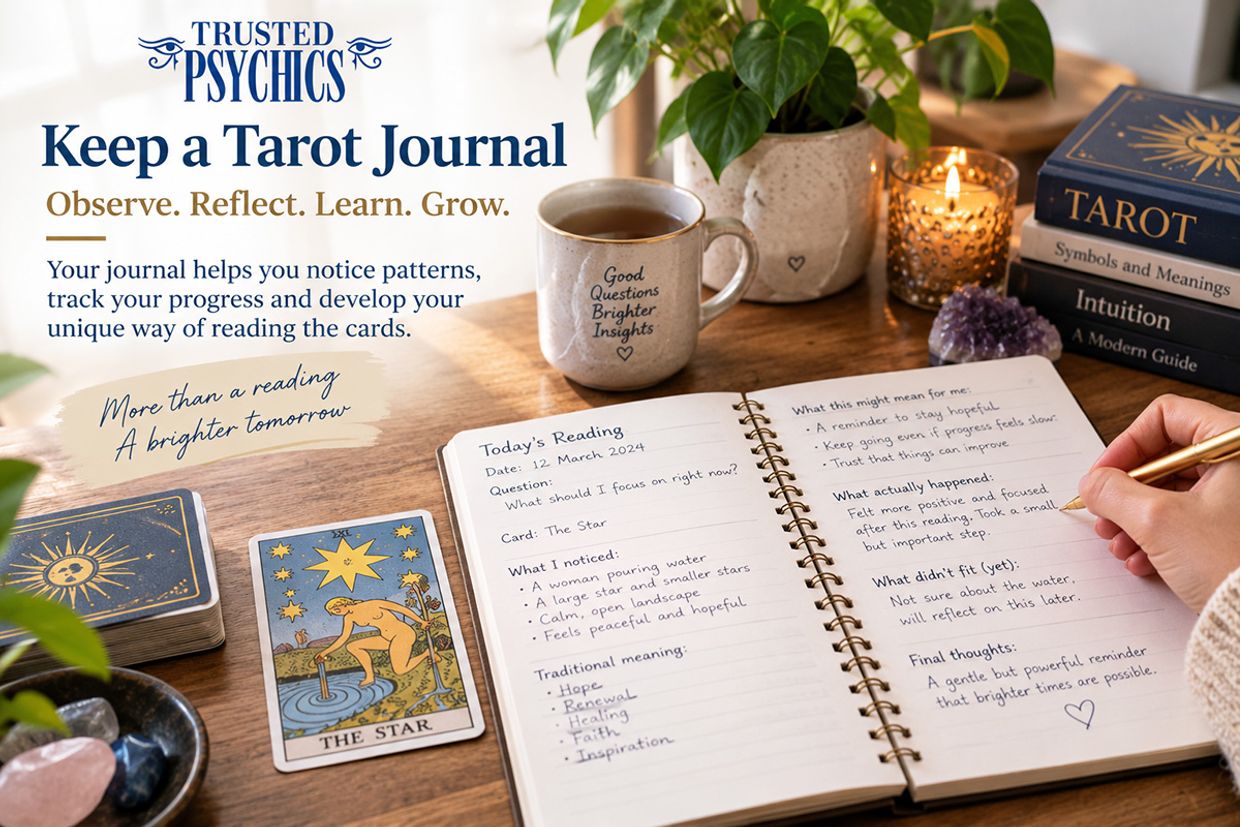
I strongly advise all my students that one of the best ways to improve their tarot readings is to keep a daily tarot journal.
When you have completed a reading, make notes about the questions that were asked, the cards that were drawn in the spread and their positions, the symbols that were relevant to the question and anything you did not understand.
Then, a couple of weeks later, return to your journal and review your initial interpretation. Look at what made sense, what didn't and where you may need more practice.
Joanne's Tip: Don't change your original reading to match what happened. Keeping an accurate record will gradually help you see where your knowledge of the cards led you in the right direction or when you concentrated too much on the cards traditional meaning without considering the other cards in the spread.
Your tarot journal will help you see patterns and how different cards work together, which will improve your reading skills over time.
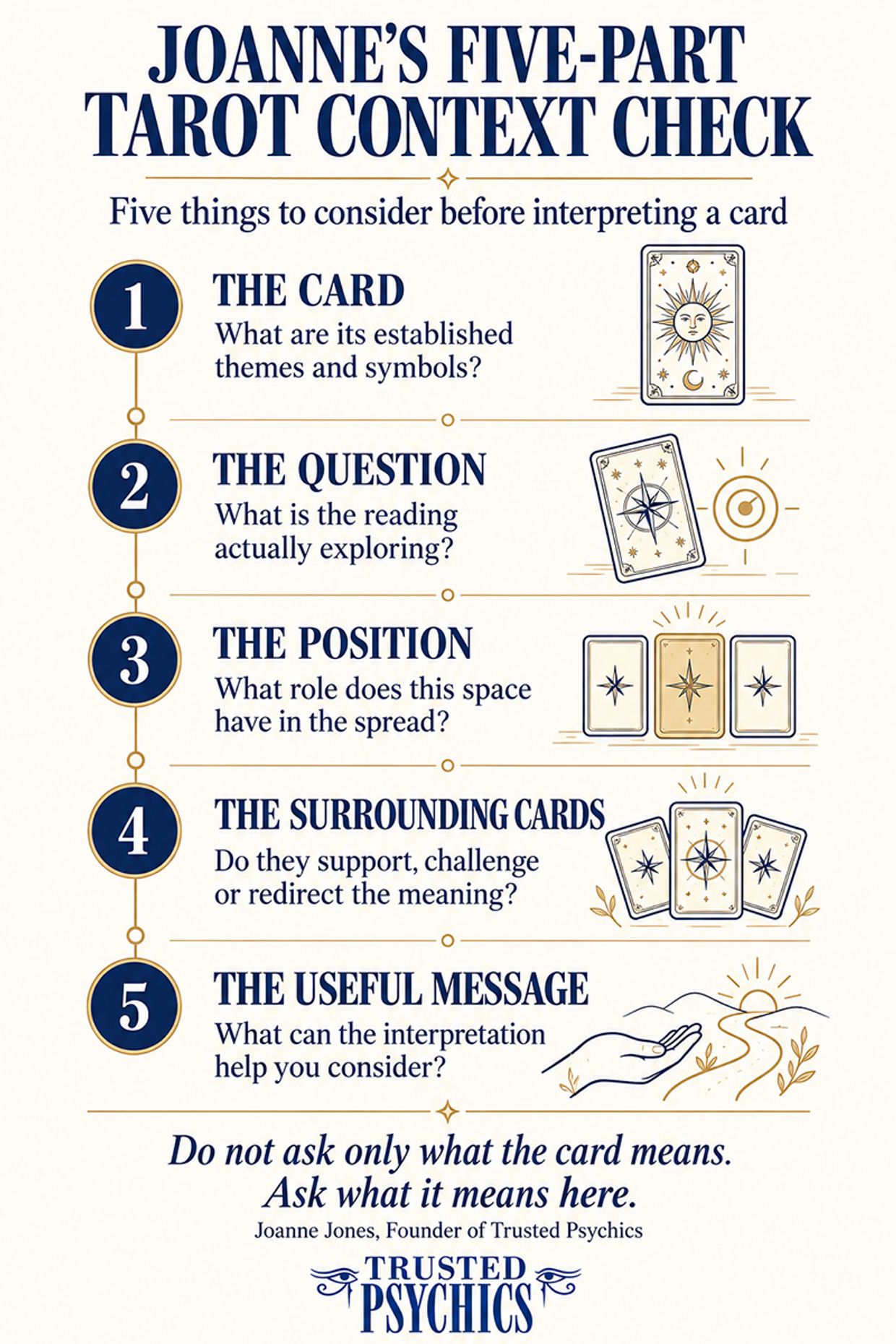
Joanne Jones' Five Questions Before You Interpret a Tarot Spread
When learning how to read tarot cards, I encourage my students to ask themselves five simple questions before deciding what a spread means. These questions can help you provide more balanced interpretations.
Question: Why It Matters
What do I actually see? Start with the card's image and symbolism before deciding the meaning.
What's the traditional meaning? Learn the card's meaning as the base for your reading.
What position is it in? Is it representing the past, present, challenge, advice, or possible guidance?
What are the surrounding cards doing? How do the other cards relate to one another?
Am I reading what I see or what I want to hear? Understand when your hopes and fears can influence a reading.
That final question is particularly useful in self-readings. If you desperately want an ex to return, positive cards can start looking like reconciliation even when the spread doesn't clearly support that conclusion.
Maybe you're worried a relationship will end; difficult cards can begin to look like confirmation of a breakup.
If you're exploring reconciliation, our Tarot Cards for Reconciliation guide looks at those themes without treating individual cards as guarantees.
What Questions Can You Ask Tarot Cards?
When you ask your tarot cards questions, keep them relevant to your life, so you can gain the most useful information from your reading.
If you have been having trouble at work, you can ask, “What do I need to know about my job?” You may pull cards that pertain to your work life, such as communication or working hard.
Maybe you are not sure about a new relationship; you can ask “What do I need to know before I fall in love?”
Just remember to ask questions that you will receive helpful information from.
What Tarot Questions Should You Ask About Love?
Love and relationships are among the most common reasons people seek psychic and Tarot readings.
Our Trusted Psychics Customer Survey 2026, based on 1,622 voluntary responses, revealed that 92% of surveyed customers sought love or relationship guidance, while 73% sought reassurance after a breakup.
These findings reflect my experience speaking with customers over the years. Relationship uncertainty can leave people feeling confused, anxious, or struggling with unanswered questions about someone they care about.
Some of the most common questions people ask include:
Why has my partner become distant?
When will I meet my soulmate?
What does the future hold for my relationship?
Will I find love again after a breakup?
When teaching beginners how to read Tarot cards, I encourage them to explore these questions rather than expecting a definite prediction about another person's feelings or actions.
For example, instead of asking, "Will my ex come back?", you could ask, "What do I need to understand about my previous relationship?" Or instead of "When will I meet my soulmate?", ask "What should I consider when looking for a meaningful relationship?"
Open-ended questions can often help those new to learning Tarot, as they allow for more detailed interpretations while practising the flow of the reading. You can explore romantic card meanings further in our Love Tarot Readings guide.
The Trusted Psychics Customer Survey 2026 revealed that 92% of surveyed customers had requested readings about love and relationships, which reflects my own experiences throughout my years of speaking to clients.
These results highlight that people often find relationship uncertainty overwhelming, leaving many unanswered questions about their love life, which can cause confusion and anxiety and is one of the main reasons people often seek a love tarot reading.
73% of customers surveyed were experiencing a difficult breakup and wanted to know if their ex still loves them, or they may be curious to know, "Will my ex-return?"
Many clients first question will be Does he love me? or why has he become distant towards me? Often, we hear there are trust issues, and people are thinking about leaving their relationship and maybe asking When will I meet my soulmate?
Tarot cards cannot tell you with certainty if someone loves you or what they may do, but you can use specific questions to reflect on what you may have learned from your past relationships.
You can explore romantic card meanings further in our Tarot Cards Meanings Complete Guide.
The survey collected 1,622 voluntary responses from Trusted Psychics UK customers, with all responses recorded anonymously.
What Tarot Questions Can You Ask About Work and Career?
Career readings can help when feeling uncertain or anxious about your job or a change of career.
When asking the Tarot about your career, instead of asking “Will I get the job?” you can ask, “What can I do to ensure I get this job?”
If you are thinking about leaving a job, you can ask, “What do I need to know before I leave?” or " Do I have the necessary skills to start a new position at this time?”
By asking these types of questions, you can look at your career goals and the opportunities you could embrace to improve your work life.
Can You Ask Your Tarot Cards Yes or No Questions?
Yes, you can ask yes/no questions to your tarot cards; there are even spreads created for this that beginners find really helpful.
If you were to ask, Should I move houses? And if the Fool was drawn from the spread, this may indicate yes, as the Fool represents new beginnings and a positive sign for change.
You could also ask yourself, what do I need to know before moving houses? This will allow you to look at why you want to move and if you're ready for the change.
Joannes Tip for Beginners: Always take a moment to think of your question before you shuffle your cards. If your question is going to be Will they? Or will I? Change that question to what do I need to know?
Keep your questions simple about what you want out of your reading and ask your cards accordingly.
Common Tarot Mistakes Beginners Make
I believe one of the best ways to avoid common Tarot reading mistakes is to learn from an experienced Tarot teacher who can guide you and help you understand traditional card meanings. Having an experienced teacher to answer your questions and build your confidence can make learning Tarot much easier and more enjoyable.
Here are five common Tarot reading mistakes and how to avoid them.
Ignoring the Question
1. Always focus on the question. While you're laying out your spread, it’s important to focus on the situation and bring your interpretation back to what was actually asked.
2. Overthinking what cards can mean. There will never be a case where the Death card means you are going to die or when the Tower appears in the spread that your life will be in turmoil. Know the traditional meanings of your cards.
3. Definite Predictions. Your readings should be used as guidance and not definite events that will happen, as there are many things that can change any outcome.
4. Pulling too many cards. When you don't understand what a card may be telling you, try not to pull more. Go by the traditional meanings of the card and its imagery or where it falls in your spread.
5. Remembering only good readings. If a reading didn't make sense for you, don't disregard it. Write down all your readings in your tarot journal even if you didn't understand it, as we learn from our mistakes.
Can Tarot Cards Predict the Future?
Tarot is traditionally used for divination, so future possibilities have always been part of tarot practice. However, that doesn't mean a spread can establish a fixed future.
A future-position card can be interpreted as a direction, possibility or outcome based on the situation you're exploring.
Future outcomes aren't set in stone, and that's an important principle to remember. People change their minds; difficult situations get resolved, and new opportunities can arise. It's important to remember that future interpretations represent possibilities rather than 100% accurate predictions.
How Long Does It Take to Learn Tarot?
There's no point at which somebody suddenly “finishes” learning Tarot. You can quickly understand the deck's basic structure and start using simple spreads.
With regular practice, you may gradually recognise more cards without reaching for the guidebook, while combinations and patterns usually become easier over time.
To allow your confidence to grow and to provide tarot readings that flow naturally takes months or even years of practice using different spreads and with different questions.
I believe that to become a good Tarot reader, you need a whole host of skills, with a genuine passion for learning and an enjoyment of communicating with people from all walks of life. Learning the tarot meanings is crucial to providing meaningful readings, but also the skills of listening and showing empathy when making your interpretations are vital to becoming a first-class tarot reader.
Tarot Cards for Beginners FAQs
Do I Need to Cleanse Tarot Cards Before Using Them?
Many readers like to cleanse their deck by reshuffling, by passing smoke over them, leaving them out in the moonlight, or just clearing your mind before you read. Some readers don't cleanse their cards at all. Make this your own choice if you feel that it's a spiritual practice for you.
What Should I Do If I Don't Understand a Tarot Card?
Take a few moments to study the imagery on the card and refer to your guidebook to understand the card's traditional meaning. If you can't work it out, write it down and come back to it. Don't draw more cards for clarity over and over.
Should I Reshuffle If I Don't Like the Answer?
It's normal to not like your Tarot reading, especially if you're asking about someone you care about.
Reshuffling your cards and getting a different answer will only confuse your reading and what your cards may be trying to tell you.
Final Thoughts From Joanne Jones
If there was one piece of advice I could give to beginners learning how to read Tarot cards, it would be to have patience, communicate clearly, keep learning, and enjoy the experience.
Having taught Tarot to students from around the world, I believe that becoming a good Tarot reader takes more than simply knowing the traditional meanings of all 78 cards.
You need a genuine passion for Tarot, a willingness to keep learning and an enjoyment of communicating with people from all walks of life. Being able to listen, understand people's feelings and explain your interpretations with kindness and compassion is just as important as knowing the cards.
In my experience, the best Tarot readers are those who genuinely love what they do, take pride in their readings, and have a natural interest in helping others.
At Trusted Psychics, we've been providing psychic readings since 1992, and I personally vet all new Psychic and Tarot readers before welcoming them to our team.
If you would like to experience how a professional Tarot reader interprets the cards, you can browse our 400+ Psychic and Tarot reader profiles, learn about their experience and reading styles, and choose someone you feel comfortable speaking with.
Joanne Jones | Founder, Trusted Psychics.
We Think You’ll Love These …..
Tarot Card Meanings: All 78 Tarot Cards Explained
How We Vet Psychic & Tarot Readers
How To Contact A Trusted Psychic
Phone a live Psychic 24 hours a day
View all our live phone psychic and tarot readers online.
View All Live readersMessage a live Psychic 24 hours a day:
View all our live messenger psychic and tarot readers online.
launch messenger
Recent Articles From the Trusted Psychics Blog

3 Card Career Tarot Spread
Learn how to use a 3-card career Tarot spread with Joanne Jones. Explore card meanings, job opportunities, and career choices with a practical worked example

The High Priestess Tarot Card Meaning
Discover the High Priestess Tarot card meaning in love, feelings, upright and reversed readings, with Joanne Jones' insights, symbolism, and card combinations.

Tarot Card Meanings: All 78 Tarot Cards Explained
Discover the meanings of all 78 Tarot cards, including Major and Minor Arcana, upright and reversed meanings, suits, Court Cards and expert interpretation.

Top 10 Tarot Readers UK
Meet our Top 10 Tarot Readers in the UK. Compare experience, reading styles, specialisms and verified profiles to find a trusted Tarot reader in the UK.

Tarot Cards for Reconciliation
Which tarot cards mean your ex may return? Learn the top reconciliation cards, combinations & timing clues from Trusted Psychics, the professional tarot readers.

9 of Cups Tarot Meaning
Discover the 9 of Cups tarot meaning in love, career, & money, plus yes/no guidance, and reversed messages. Written by Joanne Jones for Trusted Psychics.