

To pay for your reading on your telephone bill, simply call
Instantly message our featured psychics online via psychic messenger.
Click to start
Register now to start your reading online. PSYCHIC MESSENGER- Cheapest psychic service in the UK
- Our readers are available 24/7
- 100% confidential service
- In-depth, concise, personal readings
- Thousands of 5* reviews
Published 02/09/2022 • Updated 27/10/2026 by Joanne Jones
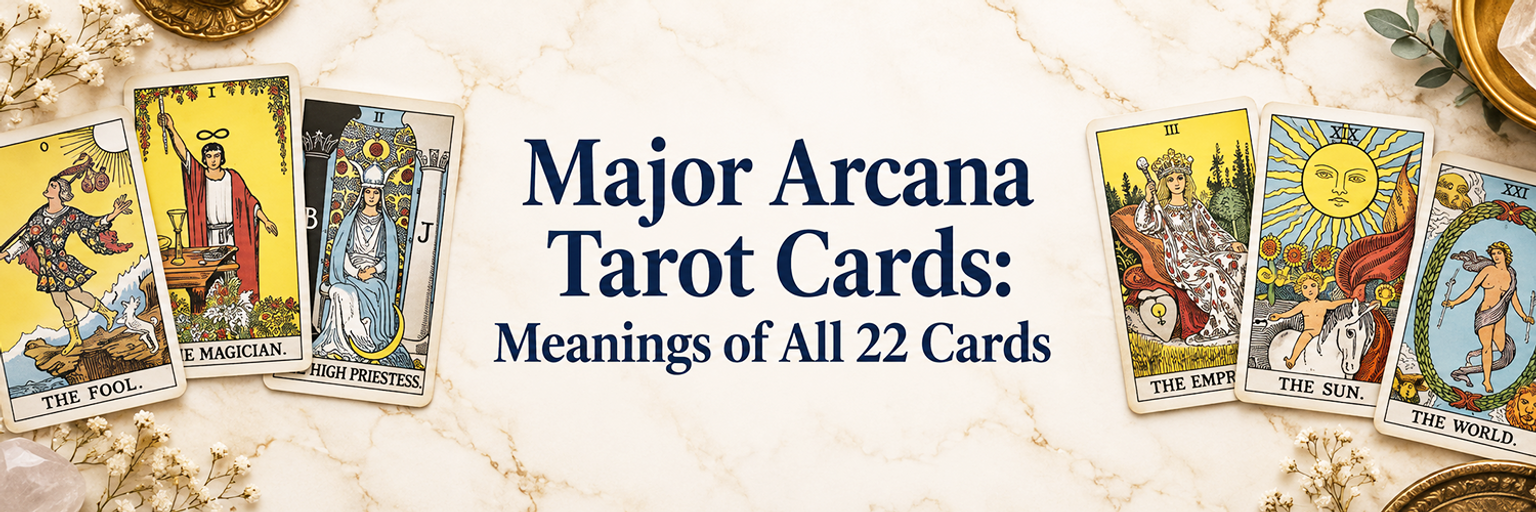
Major Arcana Tarot Cards: Meanings of All 22 Cards
By Joanne Jones, Founder of Trusted Psychics
The Major Arcana are the 22 tarot cards people seem to remember, as they represent the most important experiences in life, from love and relationships to spiritual development, decisions, and new beginnings.
There are many well-known Tarot Cards that people will recognise when they see them, such as The Lovers, Death, The Tower, and The Sun, but after more than 30 years around psychic and tarot readings, I've found that the cards with the most dramatic names are often the ones most easily misunderstood.
Since founding Trusted Psychics in 1992, my experience studying Tarot and teaching students from around the world has shown me that understanding the cards involves much more than remembering their traditional meanings.
Together, the 22 Major Arcana explore the bigger themes running through our lives: relationships, identity, choices, change, responsibility, and personal growth. They sit alongside the 56 Minor Arcana cards to make up the standard 78-card tarot deck.
The Lovers can be about a choice as much as a relationship. Death often concerns an ending you are already experiencing. The Tower may bring an uncomfortable realisation into focus.
This guide explains all 22 cards, their upright and reversed themes, and how to interpret them together. I use the popular Rider–Waite–Smith tradition tarot cards, although other decks sometimes use different names, imagery or numbering.
What Do the Major Arcana Represent?
The Major Arcana describe experiences most of us recognise: starting again, questioning what we have been taught, committing to a decision, losing our way, or reaching the end of something important.
Readers often call these cards archetypes, which means the figures and situations on the cards represent familiar patterns of human experience. The Emperor, for example, brings authority and structure into view. The Hermit explores reflection and the search for understanding.
Some tarot traditions describe these themes as spiritual lessons. You can also approach them through the practical questions they raise. Where do you need a clearer boundary? What are you ready to leave behind? Are you making a choice because it suits you, or because it is expected?
A Major Arcana card does not have to describe a dramatic event. Sometimes the important shift is in how you understand a situation that has been there for years.
The 22 Major Arcana Tarot Cards: Upright & Reversed Meanings
The table below gives you a quick reference. The core themes summarise common upright meanings, while the reversed themes show ways those meanings may be blocked, resisted, or expressed differently.
| No. | Tarot Card | Core Themes | Reversed Themes |
|---|---|---|---|
| 0 | The Fool | Beginnings, openness, possibility. | Hesitation, recklessness, poor preparation. |
| I | The Magician | Ability, action, intention. | Unused potential, manipulation, scattered effort. |
| II | The High Priestess | Intuition, observation, inner knowledge. | Ignored intuition, disconnection, difficulty listening inwardly. |
| III | The Empress | Nurturing, creativity, abundance. | Neglect, creative blocks, over giving. |
| IV | The Emperor | Structure, stability, responsibility. | Control, rigidity, weak boundaries. |
| V | The Hierophant | Tradition, learning, shared beliefs. | Questioning convention, restrictive beliefs, independence. |
| VI | The Lovers | Connection, values, meaningful choices. | Misalignment, indecision, relationship tension. |
| VII | The Chariot | Direction, determination, self-control. | Lost direction, competing priorities, forcefulness. |
| VIII | Strength | Courage, patience, compassionate confidence. | Self-doubt, impatience, reactive behaviour. |
| IX | The Hermit | Reflection, solitude, inner guidance. | Isolation, avoidance, reluctance to seek support. |
| X | Wheel of Fortune | Cycles, changing circumstances, turning points. | Resistance to change, repeated patterns, setbacks. |
| XI | Justice | Fairness, truth, accountability. | Imbalance, dishonesty, avoided responsibility. |
| XII | The Hanged Man | Pause, acceptance, a different perspective. | Stalling, resistance, unhelpful sacrifice. |
| XIII | Death | Endings, transition, letting go. | Clinging to the past, delayed change, stagnation. |
| XIV | Temperance | Balance, moderation, integration. | Excess, impatience, lack of balance. |
| XV | The Devil | Attachment, temptation, limiting patterns. | Recognising restrictions, release, confronting dependencies. |
| XVI | The Tower | Disruption, revelation, unstable foundations. | Avoided upheaval, resistance, internal reassessment. |
| XVII | The Star | Hope, renewal, openness. | Discouragement, lost confidence, difficulty trusting. |
| XVIII | The Moon | Uncertainty, imagination, subconscious feelings. | Emerging clarity, confronted fears, lingering confusion. |
| XIX | The Sun | Joy, clarity, vitality. | Muted optimism, delayed satisfaction, overconfidence. |
| XX | Judgement | Reflection, awakening, responding to a calling. | Self-criticism, avoidance, reluctance to move forward. |
| XXI | The World | Completion, achievement, integration. | Unfinished business, delayed closure, feeling incomplete. |
Strength is numbered VIII and Justice XI in the Rider–Waite–Smith deck. Some traditions, including many Marseille decks, put Justice at VIII and Strength at XI.
Reversed meanings also vary between readers. An upside-down card does not automatically become negative or mean the opposite of its upright interpretation.
The Meanings of All 22 Major Arcana Cards
All 22 of the Major Arcana have meanings that can relate to every stage of our lives, from new beginnings, love, adversity, and growth.
I believe when learning about Tarot it's important to know what each card means traditionally and its symbolism, as well as relating those meanings to your question.
Here are my interpretations of the 22 cards and what they can mean, along with examples of how you can apply these meanings to your life.
0 — The Fool
Traditional meaning: New Beginnings, taking chances and being free.
The Fool marks the beginning of something unfamiliar when enthusiasm arrives before certainty. Starting a course, exploring a new opportunity, or trying something you have always put off can all fit its theme; the cliff edge in the Rider–Waite–Smith image also invites you to notice where you are stepping.
Ask yourself: What would help me begin without overlooking sensible preparation?
1 — The Magician
Traditional meaning: Manifestation, ability, confidence, and action.
The Magician is about putting your abilities to use. The objects from the four tarot suits on his table make the idea visible: look at the resources you already have, then consider what you can do with them.
Ask yourself: What skills or opportunities are available to me now that I have not yet used?
II — The High Priestess
Traditional meaning: Intuition, mystery, inner wisdom, and hidden knowledge.
The High Priestess brings attention to intuition, quiet observation, and things you have not fully understood. Rather than rushing to explain an uneasy feeling, you might give yourself time to notice it and gather more information.
Ask yourself: What have I picked up on, and what still needs checking?
III — The Empress
Traditional meaning: Abundance, nurturing, creativity, and growth.
The Empress concerns nurture and growth, whether you are caring for someone, developing an idea or making your home more comfortable. Her wheat and leafy surroundings connect the image with abundance and the conditions that allow life to flourish.
Ask yourself: What needs care and attention before I can expect it to grow?
IV — The Emperor
Traditional meaning: Authority, stability, structure, and responsibility.
The Emperor introduces structure, responsibility, and boundaries. A timetable that makes a busy week manageable fits this card, as does a conversation about who makes decisions and whether those decisions are fair.
Ask yourself: Where do I need firmer structure, and where has it become too rigid?
V — The Hierophant
Traditional meaning: Spiritual guidance, education, and shared beliefs
The Hierophant represents established teaching, traditions, and shared beliefs. It may relate to learning from a mentor, making a formal commitment or questioning an expectation you have followed simply because it was familiar.
Ask yourself: Which traditions support me, and which no longer fit?
VI — The Lovers
Traditional meaning: Love, relationships, harmony, values, and important choices.
The Lovers connects relationships with values and meaningful choices. You might care deeply about someone while discovering that you want different futures; equally, the card can apply to a decision about the kind of life you want to lead.
Ask yourself: Is this choice consistent with what matters to me?
VII — The Chariot
Traditional meaning: Determination, willpower, direction, and self-control.
The Chariot is about choosing a direction and keeping your efforts on course. It is especially relevant when competing priorities are pulling you several ways, and progress depends on deciding what comes first.
Ask yourself: What am I working towards, and what keeps distracting me?
VIII — Strength
Traditional meaning: Courage, patience, compassion, and inner strength.
Strength explores courage that does not depend on force. The woman calmly attending to a lion in the Rider–Waite–Smith image helps explain why patience, compassion and control over your reactions belong to this card.
Ask yourself: How can I hold my ground without making the situation harsher?
IX — The Hermit
Traditional meaning: Solitude, introspection, wisdom, and spiritual reflection.
The Hermit makes room for thought away from other people’s opinions. His lantern offers a useful image for learning: you may be able to see the next step without having the entire path worked out.
Ask yourself: What becomes clearer when I give myself time to think?
X — Wheel of Fortune
Traditional meaning: Change, cycles, turning points, and unexpected opportunities.
Wheel of Fortune concerns changing circumstances and the cycles we move through. A shift in work, routine or opportunity may require you to adjust, particularly when you cannot choose the timing.
Ask yourself: What can I influence, and what do I need to adapt to?
XI — Justice
Traditional meaning: Fairness, truth, accountability, and consequences.
Justice asks for an honest assessment of facts, decisions, and consequences. It can bring a practical issue into focus, such as an agreement that needs reviewing or responsibilities that have quietly become uneven.
Ask yourself: What would be fair when everyone’s actions and responsibilities are considered?
XII — The Hanged Man
Traditional meaning: Surrender, patience, sacrifice, and a different perspective.
The Hanged Man suggests a pause that changes your perspective. Waiting can be frustrating, but it may also reveal that the approach you have been pushing is no longer the most useful one.
Ask yourself: What might I see differently if I stop forcing an answer?
XIII — Death
Traditional meaning: Endings, transformation, transition, and new beginnings.
Death represents endings and the transition that follows. Leaving a role, releasing an old expectation, or accepting that an arrangement has run its course are everyday examples of its symbolism.
Ask yourself: What am I trying to preserve that has already changed?
XIV — Temperance
Traditional meaning: Balance, moderation, patience, and harmony.
Temperance is about finding a workable balance between different needs. That might mean adjusting a routine, making a compromise, or choosing a pace you can sustain.
Ask yourself: What small change would make this easier to live with?
XV — The Devil
Traditional meaning: Attachment, temptation, restriction, and unhealthy patterns.
The Devil draws attention to attachments and patterns that restrict your choices. Seeking approval, returning to an unhelpful habit or staying with something because leaving feels difficult can all belong to this theme.
Ask yourself: What keeps pulling me back, and where could I begin to change the pattern?
XVI — The Tower
Traditional meaning: Disruption, sudden change, revelation and breaking down old structures.
The Tower concerns disruption or a realisation that challenges what seemed secure. Sometimes this is an external change; sometimes it is the moment you admit that a plan rests on an assumption that does not hold up.
Ask yourself: What needs reassessing now that I know more?
XVII — The Star
Traditional meaning: Hope, inspiration, renewal, and healing.
The Star brings hope and renewal into view after a difficult period. Its meaning can be quite modest: accepting encouragement, finding a goal you care about or beginning to trust your own judgement again.
Ask yourself: What would help me feel that moving forward is possible?
XVIII — The Moon
Traditional meaning: Illusion, uncertainty, intuition, and the subconscious.
The Moon explores uncertainty and the way feelings can fill gaps in information. It can be a useful prompt when you are trying to untangle what happened from what you fear may have happened.
Ask yourself: What do I know, and what am I assuming?
XIX — The Sun
Traditional meaning: Happiness, success, clarity, and vitality.
The Sun represents clarity, enjoyment, and a sense of vitality. Recognising progress, sharing good news, or allowing yourself to enjoy an achievement all fit its theme.
Ask yourself: What is going well that I have barely stopped to appreciate?
XX — Judgement
Traditional meaning: Awakening, reflection, renewal, and important decisions.
Judgement asks you to review what you have learned and decide how to respond. It might concern taking responsibility, returning to a neglected ambition or recognising that you are ready to make a different choice.
Ask yourself: Knowing what I know now, what deserves a different response?
XXI — The World
Traditional meaning: Completion, achievement, fulfilment, and integration.
The World represents completion and bringing an experience together. Finishing a qualification or project is one example; recognising how much you have learned through a demanding chapter is another.
Ask yourself: What can I acknowledge as complete before moving on?
For detailed love, career, symbolism and reversed interpretations, explore the individual tarot card meaning guides.
Joanne’s Perspective: Understanding Death Beyond Its Name
In my Death tarot card meaning guide, I explain the card through transition, renewal, and the release of old patterns. I use examples including changes in work, relationships and life stages.
That gives you a more useful starting point than reacting to the title alone. An ending might be something you have chosen, something you are resisting or something you are already living through. The reading needs to establish which interpretation fits.
The Death card should not be used to predict someone’s death.
Major Arcana Vs Minor Arcana: What Is the Difference?
The Major Arcana often describe the broader theme of a reading. The Minor Arcana add detail about how that theme is experienced in everyday life.
| Feature | Major Arcana | Minor Arcana |
|---|---|---|
| Number of cards | 22 | 56 |
| Organisation | Individually named cards, usually numbered 0 to XXI. | Four suits: Cups, Wands, Swords and Pentacles. |
| Main focus | Identity, values, transitions and broader patterns. | Emotions, actions, relationships and practical circumstances. |
| Examples | The Fool, The Lovers, Death, The World. | Two of Cups, Eight of Pentacles, Queen of Swords. |
| Structure | No suits or court-card groups. | Each suit contains an Ace to Ten and four court cards. |
| Contribution to a reading | Helps explore the theme or wider significance. | Shows how that theme may appear or be acted upon. |
| Useful questions | What matters here? What am I reconsidering? | What is happening? What could I do next? |
For example, The Emperor alongside the Eight of Pentacles could connect a need for organisation with steady practice.
If the question concerns learning a new skill, the combination might prompt you to set aside regular time rather than relying on occasional bursts of effort.
The complete guide to tarot card meanings explains how the Major Arcana, the four suits and the court cards fit together across the whole deck.
How Does Joanne Interpret Major Arcana Cards in a Reading?
During a tarot card reading when I am interpreting the Major Arcana cards, I look beyond their traditional meanings to understand how they relate to the client's question and the surrounding tarot cards.
Understand the Question Being Asked
Knowing the meanings helps as the same card can have different meanings depending on the card’s position. For example, when the Justice card appears in a relationship reading, it may represent being fair and accountable, but in a career reading, it could also represent agreements or decisions for your career.
Look at the Card Position
Card position can play a factor when reading tarot. If the Chariot was in the advice position, you may want to read it as being determined. If it’s in the obstacles position, it could mean charging forward with no plan.
Interpret the Cards Together
Once you have all of your cards you can start to see how they all connect together. They could be building off of one another or giving different aspects to your reading.
I like to read tarot as a whole and give a reading that is clear to understand and relevant to the client’s situation.
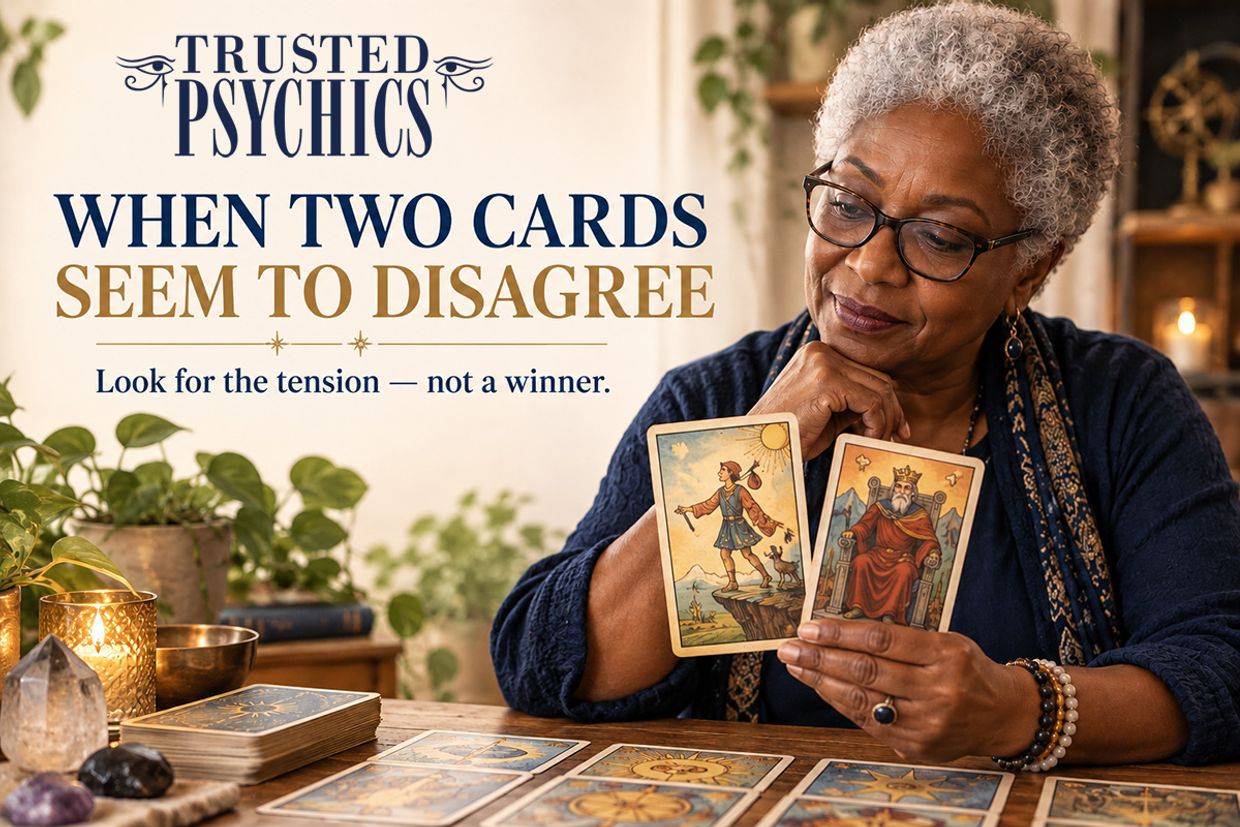
Joanne’s Insight: When Two Cards Seem to Disagree
Sometimes two cards appear to pull in opposite directions. The Fool suggests beginning something unfamiliar, while The Emperor brings structure and stability into focus. It is tempting to decide that one must cancel the other.
But that tension can be the most useful part of the reading. You may want a fresh start and still need a secure routine, a realistic budget or time to prepare. Both needs deserve attention.
Imagine considering a change of career. The question does not have to be “Should I take the leap or stay where I am?” It could become “What would help me explore this opportunity while meeting my existing responsibilities?”
You do not have to force every spread into one tidy message. Cards that seem to disagree can help you understand why a decision feels difficult, and what needs to be considered before you make it.
How Do Major Arcana Card Combinations Change the Meaning?
Combinations of Major Arcana Cards can show different types of forces at play in your reading.
The Lovers & the High Priestess
These cards represent love and the things we feel about someone but don't speak of. They could be telling you that you need to make a decision regarding your relationship and that you aren't voicing what you expect from this person.
Death & the Empress
Death shows that there is an end to something and The Empress is growth. These cards can show that there is room in your life to let something go and grow something new.
The Tower & the Star
The Tower represents destruction and The Star can be seen as a sign of hope. These cards can tell you to rebuild your self-confidence and find your way in life after something that may have destroyed your current view on things.
There are many ways these cards can be interpreted when paired with each other. It all depends on your question and position of the cards.
What Does It Mean When Several Major Arcana Cards Appear?
Having many Major Arcana cards can indicate that something is happening that you need to be mindful of. Whether it's your life or decisions you need to make.
If you get The Hanged Man, Death, and The Star together this could mean you should look at things differently. Something is ending, and you can find hope again.
But if you have 3 or more Major Arcana cards it does not mean you will experience something significant in your life.
Do Reversed Major Arcana Cards Mean the Opposite?
No, not always. When a Major Arcana card appears reversed it does not mean the opposite of the upright card meaning.
Reversed cards can mean the energy is blocked or taking longer to manifest. They can also mean something is overpowering in a situation.
An example would be The Emperor. If the Emperor was reversed, it could mean you are controlling too much or there is no structure. Or you can look at The Star reversed to mean that you may feel discouraged.
Some Tarot readers believe in reversed cards and some don't. It all depends on what you choose to work with.
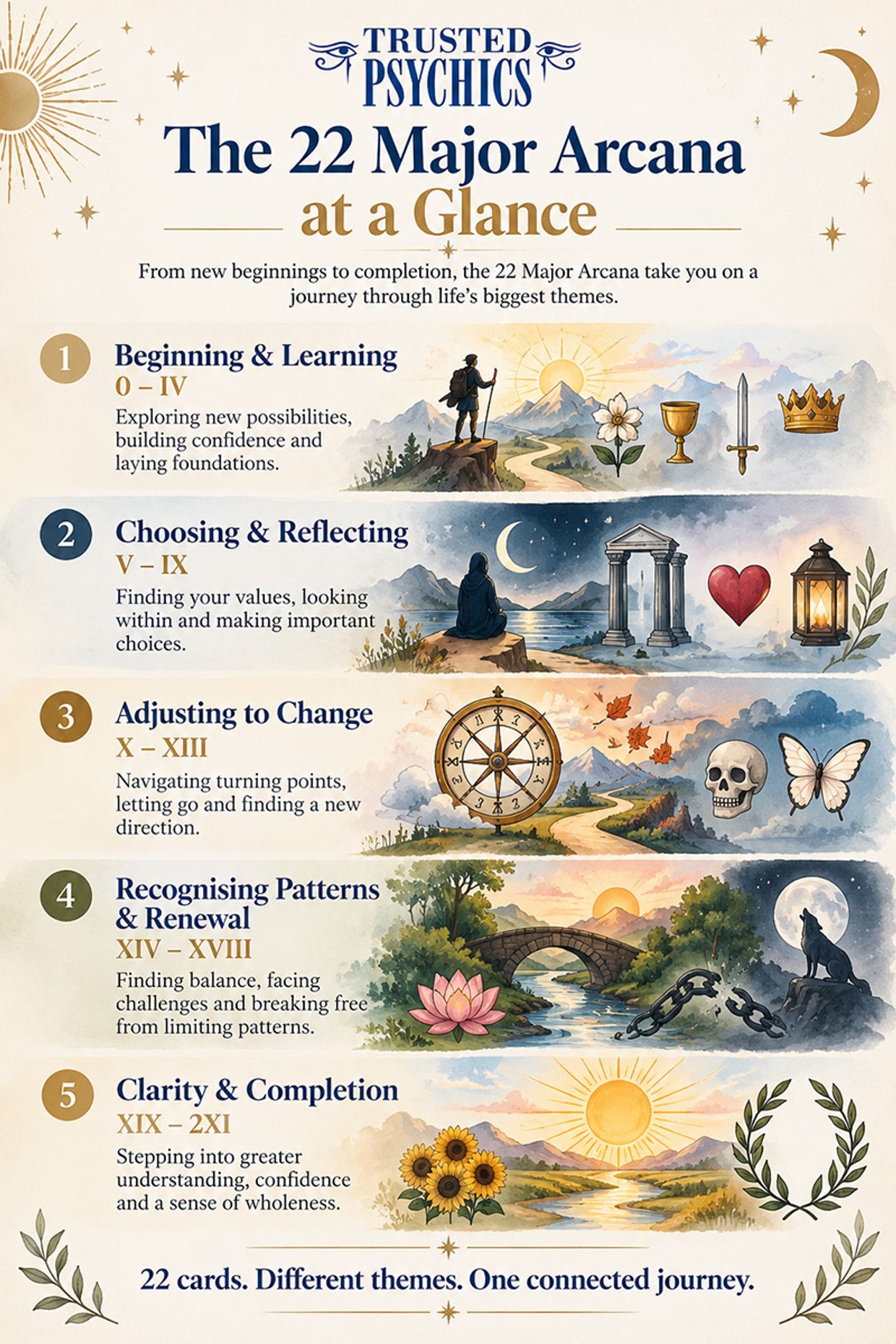
The 22 Major Arcana Cards and the Fool's Journey
Many students learn the 22 major arcana cards by following the fools journey. This teaches you about each card in the story of beginning something new.
By going through each card you can learn about the journey of life, from learning about yourself to love, hardship and beyond.
The Fool to the Hierophant: Beginnings and Learning
The Fool represents new opportunities and experiences, while The Magician explores personal abilities and The High Priestess teaches us about love and balance, followed by the Hierophants traditional values and shared beliefs.
The Lovers to the Hermit
Once you've found love, you will face decisions with The Lovers. Drive and willpower from The Chariot. Patience and strength with The Strength card.
Then take time to reflect on what you have learned so far with The Hermit.
Wheel of Fortune to Temperance: Change and Adjustment
Life will change around you with Wheel of Fortune. Take responsibility for your actions with Justice. Look at situations from another angle with The Hanged Man.
Death symbolises endings and transformation, while Temperance focuses on restoring balance.
The Devil to the Star: Challenges and Renewal
Learn from your attachments with The Devil. When something falls apart, we can gain knowledge from The Tower.
And when things seem hopeless The Star encourages positivity and provides reassurance that everything can get better.
The Moon to the World: Understanding and Completion
Uncertainty and doubt come from The Moon. Once you know what you want in life you will receive The Sun.
Take time to reflect and know when it’s time to move forward with Judgement. Then complete what you have started with The World.
The Fool's Journey is a symbolic learning framework, not a prediction of the order in which life events will happen.
Which Major Arcana Cards Matter in Love Readings?
Several Major Arcana cards are associated with love. When doing a love tarot reading these are the ones I look out for.
The Lovers represents attraction, romance, compatibility, deep bonds, while The Empress can highlight affection and nurturing.
The Hierophant may suggest commitment or shared values, and Temperance can represent compromise and emotional balance and harmony.
Cards like The Hermit can show that you need time for yourself. Or that your partner needs time. There are many other cards that can play a role in a love reading.
Tarot will never tell you that someone will love you forever or what someone else is feeling. Read our article about Tarot Cards for Reconciliation or The Lovers Tarot Card Meaning to learn more.
Joanne's Teaching Advice: How to Learn the Major Arcana
I always tell my students that when it comes to tarot don't just learn the meanings but also understand what you see on the card.
Take one card at a time. What do you think it stands for? Look at all the different aspects of the card and try to work out how you could use it in everyday life.
You could say the Magician means knowing what you can do and using it. Or Justice stand for what is fair and right.
Have a tarot journal that you can write down your meanings on and start working out what it can mean in different questions.
Once you feel more confident start doing a 3-card spread. Situation problem and solution/advice.
This is how I've learnt tarot, understanding each card and having the confidence to work out what they mean.
Frequently Asked Questions About the Major Arcana
How Many Major Arcana Cards Are There?
There are 22 Major Arcana cards in a standard tarot deck. They are usually numbered from 0, The Fool, to XXI, The World.
Can You Read Tarot With Only the Major Arcana?
Yes. Some readers use the 22 cards to explore broader themes. The Minor Arcana add detail about emotions, actions, relationships, and practical circumstances when the full deck is used.
Are Major Arcana Cards More Important Than Minor Arcana Cards?
They are often given greater thematic weight, but a Minor Arcana card can be central to the question or advice in a spread. Relevance depends on the reading, rather than the group a card belongs to.
Does the Death Card Mean Someone Will Die?
The Death card is commonly interpreted through endings, transition and letting go. It should not be treated as a prediction of someone’s death.
Does the Empress Mean Pregnancy?
The Empress has associations with fertility and nurturing, but these can also concern creativity, care, and growth. It cannot confirm pregnancy; use a pregnancy test or appropriate healthcare advice for that question.
Does the Lovers Mean Someone Is My Soulmate?
The Lovers can suggest connection, values, and meaningful choice. It does not prove that someone is your soulmate or guarantee a lasting relationship.
What If I Keep Drawing the Same Major Arcana Card?
You can revisit its theme and consider whether your understanding has changed. Repeated cards can also arise through chance, shuffling habits or frequent draws.
Can Major Arcana Cards Give Yes or No Answers?
Some readers assign favourable or unfavourable indications to cards within a particular method. There is no universal yes-or-no system, and a card cannot guarantee an outcome.
Explore Your Tarot Reading With Trusted Psychics
Since founding Trusted Psychics in 1992, I've remained committed to providing high-quality Tarot and psychic readings from experienced, compassionate readers.
Today, we have over 400 personally vetted psychic and Tarot readers, available 24 hours a day, offering different reading styles and approaches.
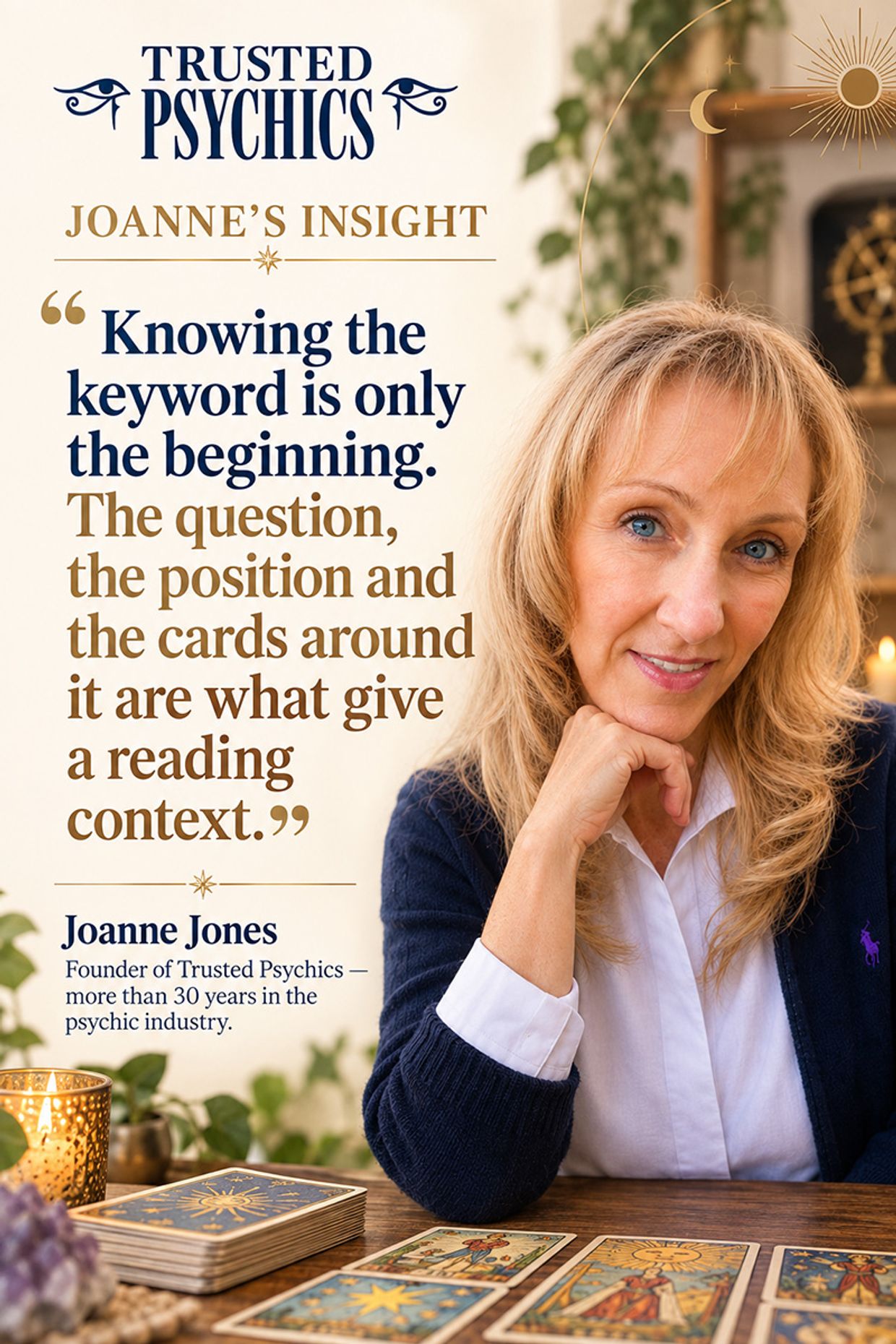
One thing I always teach my Tarot students is that knowing the traditional meanings of the cards is only the beginning. A meaningful reading comes from understanding how the cards work together and interpreting them in relation to the client's individual questions and circumstances.
If you'd like another perspective on the Major Arcana or a personal Tarot spread, explore our readers' profiles and choose someone whose approach feels right for you.
We Think You’ll Love …..
Tarot Card Meanings: All 78 Tarot Cards Explained
Psychic or Medium for Love? Which Reading Should You Choose?
25 Questions to Ask a Psychic Medium
How To Contact A Trusted Psychic
Phone a live Psychic 24 hours a day
View all our live phone psychic and tarot readers online.
View All Live readersMessage a live Psychic 24 hours a day:
View all our live messenger psychic and tarot readers online.
launch messenger
Recent Articles From the Trusted Psychics Blog

Tarot Cards for Beginners
Learn how to read Tarot cards with Joanne Jones. Follow 8 easy steps for beginners, understand card meanings, practise Tarot spreads, and build confidence.

3 Card Career Tarot Spread
Learn how to use a 3-card career Tarot spread with Joanne Jones. Explore card meanings, job opportunities, and career choices with a practical worked example

The High Priestess Tarot Card Meaning
Discover the High Priestess Tarot card meaning in love, feelings, upright and reversed readings, with Joanne Jones' insights, symbolism, and card combinations.

Tarot Card Meanings: All 78 Tarot Cards Explained
Discover the meanings of all 78 Tarot cards, including Major and Minor Arcana, upright and reversed meanings, suits, Court Cards and expert interpretation.

Top 10 Tarot Readers UK
Meet our Top 10 Tarot Readers in the UK. Compare experience, reading styles, specialisms and verified profiles to find a trusted Tarot reader in the UK.

Tarot Cards for Reconciliation
Which tarot cards mean your ex may return? Learn the top reconciliation cards, combinations & timing clues from Trusted Psychics, the professional tarot readers.